Affordable Montessori Homeschool Curriculum: How to Get Started Without Breaking the Bank
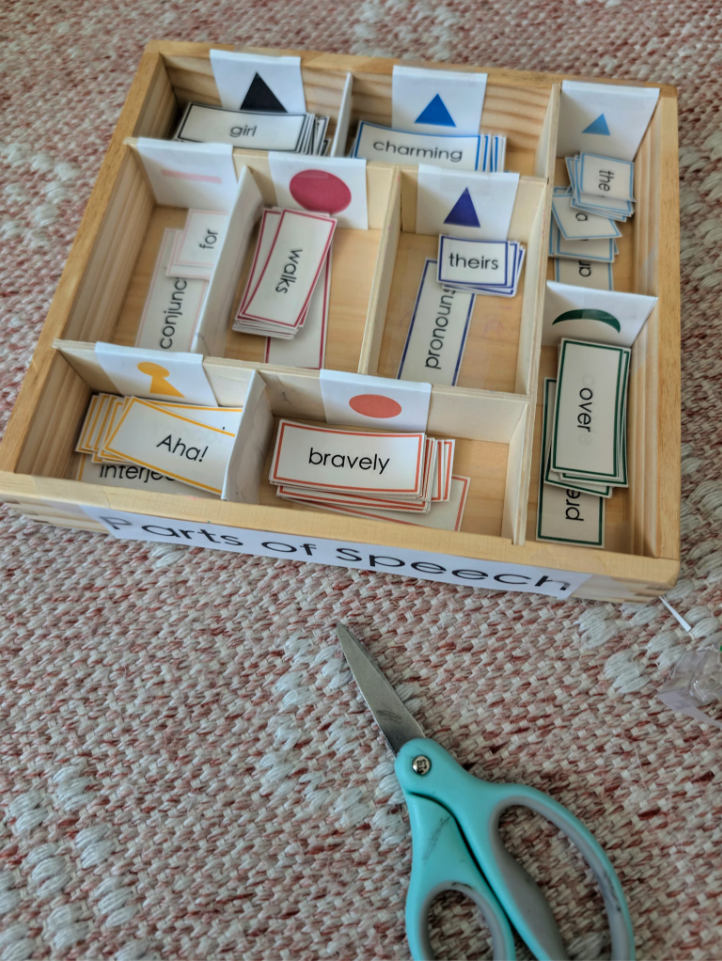
DIY grammar box used for a homeschool lesson — shared by a Child of the Redwoods member family
For many families, Montessori feels financially out of reach, and this is quite tragic because it is a scientifically proven method of education that is designed to reach every child, regardless of their age or skill level.
The images we see on social media perpetuate this stereotype, and so do private Montessori schools.
All of this leads many families to conclude: Montessori itself must be expensive, so…can we afford this?
It’s understandable to hesitate and evaluate your budget first when homeschooling. Of course you want make good financial decisions and also make the right choice. You don’t want to be locked in to the wrong method. After all, your child only gets one childhood. And you want to make the most of it.
Here’s what you need to know about Montessori. It is not a school, nor an influencer’s photogenic account. Giving your child a Montessori education is a method. It’s something you can learn and do on just about any budget.
This article will help you understand why Montessori has gained an “expensive” reputation, what truly matters when homeschooling with Montessori on a budget, and how to teach your child without an excess of materials or paid resources. This is one part of a larger Montessori framework, and if you’d like to see how everything fits together across ages and subjects, you can explore the full picture in Montessori Homeschool Curriculum for Ages 2–9 (Comprehensive Guide).
Why Montessori Education Has a Reputation for Being Expensive
The idea that Montessori is costly didn’t come out of nowhere.
Most people first encounter Montessori through private schools. These schools serve many children at once, which means that they require high-quality, durable materials that must last year-to-year. The upfront cost of creating a fully-implemented Montessori classroom with all of the materials needed in order to serve children of multiple ages at one time is significant.
Add to this modest teacher salaries, insurance on the property, and other business-related costs, and you can start to understand the price of yearly tuition.
It’s important to note that the private school model is expensive by nature, but it does not guarantee a better education for your child.
At home, you are the teacher, so you don’t have to pay for one. You’ll have a reasonable number of students, not a whole room full of kids. You don’t need every material in the world because you only need the materials your child would actually use right now, and you don’t need them to last for 15-30 years either. Your child will outgrow them quickly, so it doesn’t make sense to invest as heavily.
Montessori Started Looking Like a Luxury Brand
Social media has also greatly changed the Montessori landscape in the past two decades. Once, Montessori at home was rare and fairly undefined, but now it has become a downright aesthetic. And what sells online is highly styled images that emphasize beauty over function.
You can also see that non-Montessori products have marketed themselves very well in the Montessori space, simply by being made of heirloom quality wood or beige-y fabric. Think: toddler beds shaped like houses, climbing triangles, wooden rainbow toys, rows of wooden shelving, and working mini play kitchens.
Montessori social media influencers are themselves susceptible to the branding effect! They receive products for review and often purchase toys and furniture in excess. They become blind to the consumerism they are perpetuating because it has become a hobby - and in many cases, a full-time job. Wouldn’t you want your own business storefront to look pretty and well curated? I would! So we aren’t blaming the influencers. We are just putting Montessori into perspective.
While these “Like & Subscribe” home spaces can be inspiring, they also create an impression that Montessori requires perfection with a large budget to match.
What gets overlooked is this: Montessori is a way of life, not a shopping list. The cost assumptions come from where Montessori is often practiced, not what Montessori actually is.
Montessori Can Be Surprisingly Affordable
Let’s say you do decide to commit to Montessori despite your hesitations about the potential cost. Here’s some good news for you: you can make the biggest difference without spending a dime.
Instead of buying materials right away or redesigning your home spaces, take a little time to learn the foundations. Get clear on what Montessori is (a method) and what it isn’t (more stuff). This will reduce the pressure to start with that consumerist mindset and replace it with a fresh learning opportunity for you and your child.
To use the Montessori method, you will be using specific teaching techniques like the three period lesson and moving from concrete experiences before introducing abstract ones. Learning these will take a bit of time and practice. No special materials are required. You can start with what you already have.
Montessori works because lessons are introduced intentionally and are practiced over time. Well-chosen lessons that follow a clear progression matter far more than owning every possible material.
Despite what you may have read about rotating trays on shelves, children do not need constant novelty. The same works on the same shelves will provide plenty of stimulation. The variation in teaching techniques as you work with the materials you are already using will have long-lasting benefits without an excessive rotation system.
Starting small is not deprivation! Children need far fewer things than we tend to think. In fact, a simple, uncluttered home with a few carefully chosen items for exploration and lots of opportunity for real-world engagement is preferred.
Curriculum is the Better Investment for Families
One of the most overlooked cost-saving tools in Montessori homeschooling is owning a solid, authentic Montessori curriculum. Yes, learning should be hands-on, but most people assume that every lesson begins with a specific Montessori material that needs to be purchased. This leads families to overbuying right from the start.
Purchasing materials “just in case” you’ll need them, hoping to learn the lessons later is both expensive and exhausting! Many families end up sticking these materials in a closet “for later”, and then sadly, they never gain the confidence to actually offer them to their child.
Or they may find that by the time they rememer to get out the material, their child is already proficient in the skill the material was designed to teach.
In contrast families who invest in a solid curriculum with a clear scope and sequence entirely avoid this financial headache. When you know what concepts are introduced first, what builds on them, and where learning naturally progresses, you can make thoughtful decisions. You buy (or create) what supports that next step.
Choosing curriculum over materials in the beginng is the smart move!
Resist the Urge to Overspend by Using What You Own
Before buying a single thing, start with your child’s own toys displayed on a simple shelf or organized in a supply closet. As you work through your curriculum, source your materials not from the internet but from these materials that you already own.
You are likely to find that what you already have already supports your child’s learning — or you can modify a toy slightly to make it fit Montessori principles and isolate a concept.
For example, you may start by taking out batteries so that the toy is more simple, less noisy, and encourages open-ended exploration. Many children’s toys are large sets with many colorful components. What if you were to take a few parts from a set and display it in a basket on the shelf separately, reducing overwhelm and allowing your child to concentrate on the skill and invite repetition?
Fewer materials, used well, almost always outperform shelves full of unused ones.
Over time, it will become easier to evaluate whether what you own is enough and whether the purchase of another material is necessary.
Certain Materials Are Used for Multiple Ages
Many families fear that having more than one child will double the cost of a Montessori education, but this is a myth. Teaching more than one child does not make Montessori more expensive.
Multi-age learning is actually a strength of the Montessori method, and many of the materials can be used in different ways (for different learning outcomes!) as your child grows older. For example, the same pink tower that was used to teach your 3 year old stacking and grading objects by size can be used in the elementary years to teach algebraic thinking. The golden beads introduce your child to the concept of place value, but they continue to be useful as your child explores addition with carrying, subtraction with borrowing, and even larger multiplication and division problems.
The moveable alphabet is another material you will likely have for many years. A beginner reader will use it to “write” even before they have learned to use a pencil, and an advanced reader will use it to explore and study spelling rules.
As your child Lessons and materials naturally span ages, allowing for reuse over time. Younger children benefit from observing older siblings. Older children reinforce their learning through repetition and modeling.
This longevity of materials Affordability comes from longevity. When lessons grow with your children instead of being replaced constantly, the cost evens out—and often decreases.
Spending Less Has Big Benefits
Families who prevent themselves from buying a whole setup find that beginning Montessori with a few lessons from the foundational curriculum is much more doable than they thought possible!
Starting small prioritizes strategy over excess. You’re making your life (and your child’s) easier and so much less overwhelming.
Here’s the really interesting thing that surprises parents the most: when you are ready to DIY or buy specific materials to add to your home and you do so with intention, they are often perceived as more valuable by your child. Children tend to pay more attention to materials that are very slowly added over time.
One of the biggest mistakes you can make is overloading your home environment with all of the materials all at once. Again and again, families come to us disappointed that their child has lost interest in everything after a few months.
The items on the shelf can slowly become invisible as your child’s brain is wired to constantly be looking for new stimulation. However, if you dole things out over time, the same materials may be enticing to your child for years!
Montessori On Your Own Budget
Montessori is for everyone. Not just for those who can afford everything at once. No matter how big your pocketbook, it is enough to give your child the Montessori education they deserve. The children with more toys, fancier materials, or prettier shelves will not learn more than children using measuring cups, cardboard boxes, and dried beans.
You can homeschool with Montessori thoughtfully and affordably when you focus on the lessons themselves.
If you’d like to see how a clear curriculum framework supports both learning and affordability, your next step is to read our guide about using a Montessori curriculum for homeschoolers and explore how these principles come together in practice.
Affordable Montessori can be yours. Today.