How to Support Your Child’s Natural Development at Home (a Magical Montessori Approach for Beginners)
Forget the fairies, elves, knights, and dwarves of fantasy novels…although fun, the real magic in this world is in children. Get ready, because I’m about to convince you!
Let’s start at the beginning: a simple definition.
One, single word can be packed with so much power and meaning.
Magic
/ˈmajik/
noun
the power of apparently influencing the course of events by using mysterious or supernatural forces. "suddenly, as if by magic, the doors start to open"
adjective
1.used in magic or working by magic; having or apparently having supernatural powers. "a magic wand"
2. wonderful; exciting. "what a magic moment"
verb
move, change, or create by or as if by magic "he must have been magicked out of the car at the precise second it exploded"
(Source: Oxford Dictionary)
To me, alllll of these things define so well the magic of childhood, which is: the development that occurs naturally within the child, completely unseen and uncontrolled by us.
You can’t look at the muscles and watch them growing… you just wake up one morning and realize it’s happened!
This is true with brain development, too. We cannot know our child has learned something by looking at them. We can’t see them transition from one developmental phase to another.
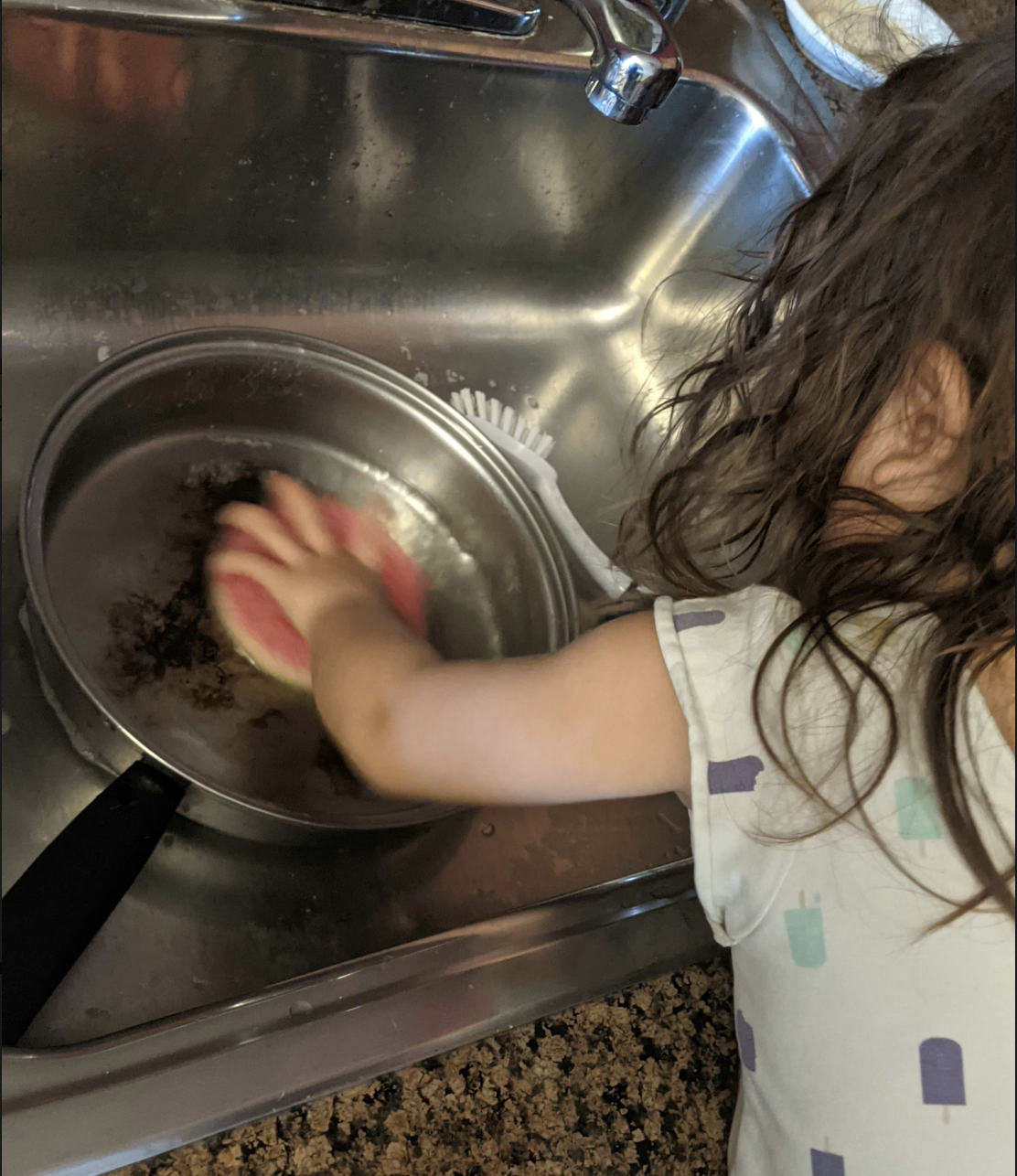
Scrubbing — practical life at age 3. Photo shared by a Child of the Redwoods family.
But we CAN observe it.
We can look for the outside signs of the inner work… we can bear witness to the course of their becoming. Even when our children are doing very household tasks — like scrubbing a dish, watering a plant, or putting on their shoes.
Maria Montessori saw magic happening via the child’s sensitive periods, and she was on target even before neuroscience was a dinnertable topic. The only way the inner needs of a child are filled is by the child going to seek out an activity that fulfills that need.
There is not some external sign other than the way the child is engaging with the world around them.
And after you study Montessori and apply the method, you start to see this kind of invisible, unfolding development happening right in front of you.
It changes the question entirely.
Instead of asking, “What should I teach next?” or “How do I make sure my child is learning enough?” you begin to wonder how to support what’s already happening.
And this is exactly where one of the most well-known tenets of Montessori appears, ready to lead you forward.
You’ve probably even heard it before: “follow the child.”
But what does that actually mean in real life?
What Does “Follow the Child” Really Mean?
To every adult’s consternation, children almost never walk in a straight line. When following our children in a garden, they are constantly deviating from the path or stopping suddenly in front of us, plopping their bottoms right down in the middle to take a shoe off or wandering off into the grass to chase a ladybug.
What is true for the garden is also true for the playroom. Distractions abound. And the rules children make for their games make no sense to us at all.
The whole idea of following our children can feel a little…aimless and confusing.
Does following the child mean letting your child do whatever they want?
Does it mean stepping back completely?
Does it mean you’re not really “teaching” at all?
Nope. Following the child is none of these. We don’t just hope that learning happens and stop engaging. No, follwing the child is about paying attention to what is happening.
Observing the moment. Noticing what they are drawn to. What they repeat. What makes them cry out in frustration and laugh with giddiness.
When we adopt this mindest, it allows us to support our children naturally in their development. Sometimes we respond by stepping back a little and giving our children more space to investigate, and at other times it means we need to take action and teach a little lesson right there and then.
This is where it gets tricky, because also we know in Montessori, many lessons are much, much more impactful when they are taught later, in sequence with the curriculum or when our children are not distracted in the moment.
But knowing that they’re coming up through our observations allows us to remember their importance and choose an appropriate lesson for the perfect time in our child’s development.
Following your child doesn’t mean guessing your way through their education or leaving things upto chance. There is a thoughtful structure underneath it all: a clear progression of skills and a sense of what comes next.
Within that structure, your child has the freedom to explore and grow in the natural, “magical” way they were indended.
I bet you’re now wondering how to actually support this kind of development at home, without overdoing it or getting in the way.
Let’s walk through that together.
How to Support Your Child’s Natural Development at Home
It starts with a calm, and loving presence.
Before teaching any skills at all or stepping in to help with daily tasks, like washing those little hands, take a breath. Take a look at your child in this present moment.
Pausing before parenting has a lot of benefits for our children. We might ask ourselves if this is a task our children might enjoy doing themselves. And if the answer is “maybe”, this is an opportunity to step back, stop talking, and see if a little Montessori magic will unfold.
Sometimes our children will surprise us with their independence when we least expect it, so this is a great practice for everyday, real life.
We don’t need to be central to every moment in our child’s life.
I know we want to witness it all, and to experience each amazing moment of growth—but our presence is not always necessary.
In fact, sometimes just by standing too close, we suppress their natural inclination to explore and become independent. And yet, we also know that developing a loving, trusting relationship with our child is essential to their well-being in every way, too. T
hey do need to feel cared for and loved beyond measure.
Doing things for our children is one of the ways that we show our love and devotion to them.
As Montessori parents, we can walk the fine line. Instead of automatically washing their hands for them, we can give them a choice verbally: “Would you like to wash your hands yourself? Or would you like to do it with me?”
We can also give them a choice silently. First, we quickly model washing our own hands, start to finish. Then we get out of their way and let them try.
I like to say, “Now it’s your turn.”
If children really want assistance, they usually do let us know! We can trust this.
Why Your Child Needs More Time to Learn
Have you ever heard that time passes more quickly when you get older? I can verify that this is true! I blink and my children are another year older.
Child-time…in contrast…is….slow.
If you have ever sat next to an 18 month old who insists on putting on her own shoe, you are beginning to understand the concept of child-time I am referring to.
Give your child more time than you think that she can possibly need.
Don’t rush her through her explorations.
Unfortunately, rushing children is a cultural norm. Even in most schools, we start with a list of skills and then methodically tick them off, pushing the children from one learning concept to the next.
Rarely do we allow them to pause and think about the significance of this skill and discover the next one on their own.
This rushing of childhood is not limited to schools, however. You see that “go go GOOOO!” mentality in sports all the time. We impress our adult concepts of success on our children--in hopes that it will help them become successful.
Think about this the next time you are out in public at a museum or cultural space where they have exhibits for children. In order to make things fair socially/societally, we often wait in lines for children to get to have an experience…and then we are forced to rush them through the experience and sometimes even do the activity or craft for them so that others don’t have to wait as long.
Our adult need for efficiency is not relevant to children. It’s not always possible, but where you can, be more mindful that what is most needed is time for discovery.
Since we cannot see the learning process, we cannot know for sure exactly what is happening, and therefore it is exceptionally important that we do not rush or push them to learn or understand new concepts.
By giving your child more time to learn, their brains can begin to make connections between subject areas, and their bodies can repeat the physical work necessary to gain new skills.
Learning new things at any age takes a lot of hands-on practice and intention. Giving your child the time to do this in their own way is a huge gift.
Do You Need Montessori Materials for This to Work?
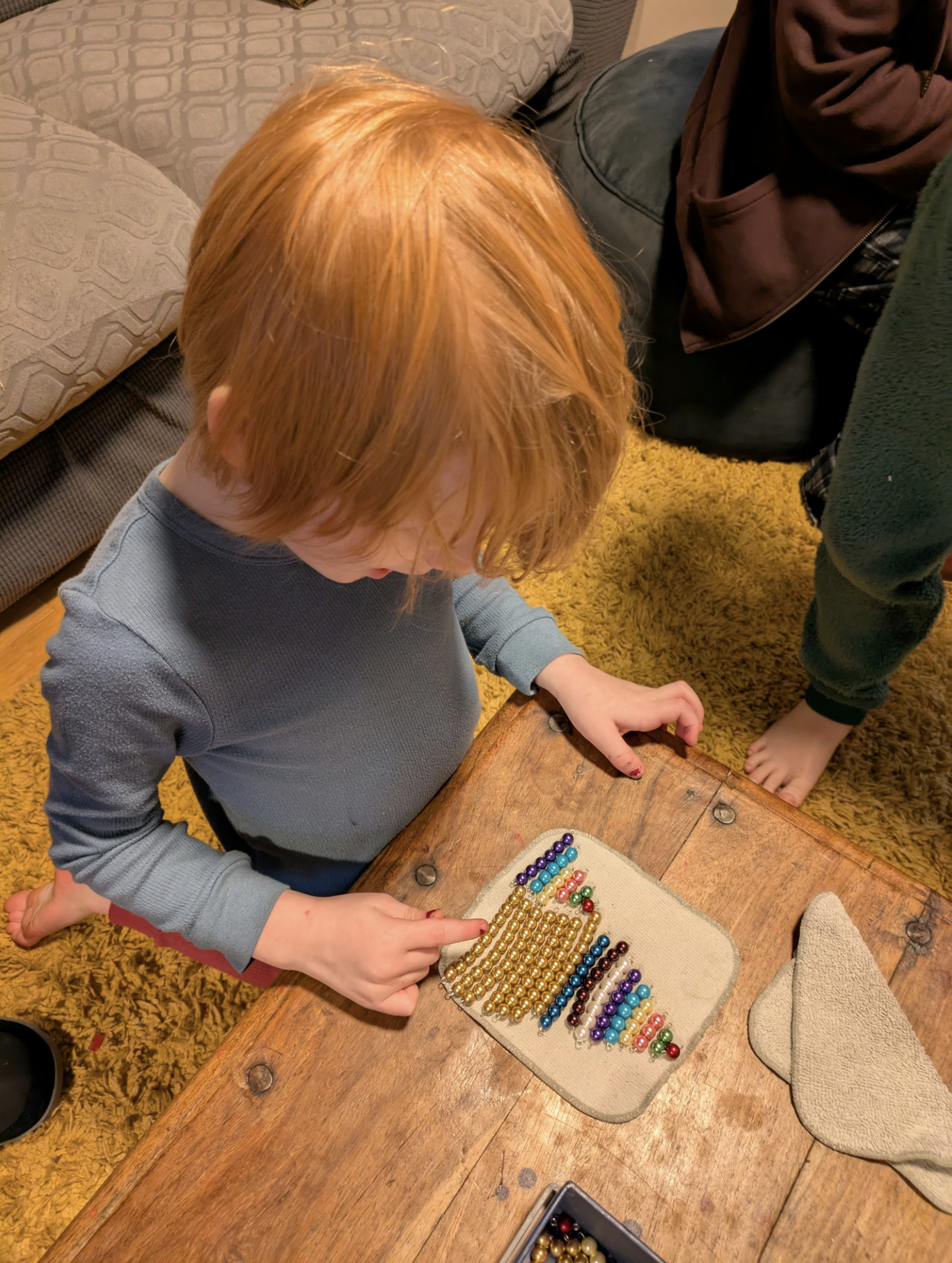
Exploring math with homemade DIY Montessori beads. Photo shared by a Child of the Redwoods family.
Many parents new to Montessori immediately fall in love with the Montessori materials, like the pink tower, red and blue rods, or the golden or colored beads. Us, too!
The learning magic is not in the material itself, however—it’s in your child.
When your child interacts with the objects in their environment, they are constantly experimenting! Twisting, turning, flipping, transporting, counting, evaluating. All this comes naturally to children.
Montessori materials are designed to lend themselves to children’s inclination to analyze things. The pink tower is perfectly graded in size from 10 cm to 1 cm.
There’s nothing about the material itself that requires children to place the largest cube at the bottom, but most children will naturally want to stack them, and they’ll see quickly that a smaller cube underneath a larger cube is not only less aesthetically pleasing…it’s also less stable!
So yes, Montessori materials can really be wonderful tools for us to give to our children.
But you do not need to have them in order for your child to learn the same skills.
You can use the objects you already own in your home, too. Puzzles, blocks, measuring cups, dried beans, refrigerator magnets, stacking dishes, craft beads, cardboard boxes. Children will learn so much from everyday objects, just tinkering with them!
And if you’re inclined to make your own Montessori materials from scratch (like the beautiful DIY math beads you see here), you’ll be joining time-honored tradition among Montessori parents around the world.
How Much Structure Does Your Child Actually Need?
The Montessori method has a foundation of structure, this is true. Children learn best when the things they are using to learn with or from (toys, tools, household objects) are accessible to them and somewhat ordered. Low shelves and baskets or trays help support this.
There is also a very clear progression to the lessons we give in Montessori; they do not interfere with your child’s natural interests — they break big concepts into smaller ones so your child can more easily understand and practice.
And yet, within the environment and lesson-giving structure, our children still have lots of freedom to explore at their own pace, in their own way.
Pretend play is also essential for your child’s development. It helps your child learn socio-emotional skills, and it also reinforces what they are learning.
Allow your child to be immersed in it, and don’t feel that it is any less valid or less important than any work on a tray. Free, unstructured play is vital.
If you have ever felt unsure about how pretend play fits into Montessori, you are not alone. (It’s a conversation worth exploring more deeply.) But for now, just know this: when your child is engaged, imagining, creating…they are doing meaningful work.
Why Nature Makes Montessori Magic Easier to Find
Nature is deeply, deeply magical. The ecosystem on Earth, as it exists today supporting life, is real, wild magic that evolves and grows.
Adult humans, plants, animals…we all exist together in a timeline that is not controlled or controllable. Add all the rambunctious, curious human children into that mix and amazing things happen!
The unstructured nature of the outdoor environment allows you to hang back and relax into the moment, making it a comfortable, healthy, happy place for children.
Because there’s less stuff to “do” outside, you are naturally more patient. The trees, water, dirt, moss, grass, rain, and other natural elements provide all of the learning opportunities, giving children so much inspiration and space to dance along their own developmental path.
If you’re feeling like things are a little dull inside the playroom, go outside and let the magic unfold itself as you step away. It’s a better learning environment than any classroom could be, and you can quote me on that!
Embracing the Montessori Magic
Sweet friend,
In this day and age, it’s easier than ever to start doing Montessori at home, embracing the magic of childhood right where you are.
You don’t need a whole setup or special materials to start teaching.
Your child’s natural development provides the impetus for learning.
A curriculum with the foundational lessons can give you the confidence you need to see your amazing child grow and flourish right before your eyes as you give little lessons and find opportunities to nurture them.
If I may offer a little suggestion for you for today, it would be this. Go spend some time with your child either in their play area or out in nature. Watch what they do. Let yourself feel grateful that they are still little, learning so much, doing what comes natural to them.
And if you’re craving a little more structure so you can relax into the role of Montessori guide, a thoughtfully prepared Montessori homeschool curriculum is here for you when you’re ready to start.