The Best Homeschool Curriculum for Overwhelmed Parents
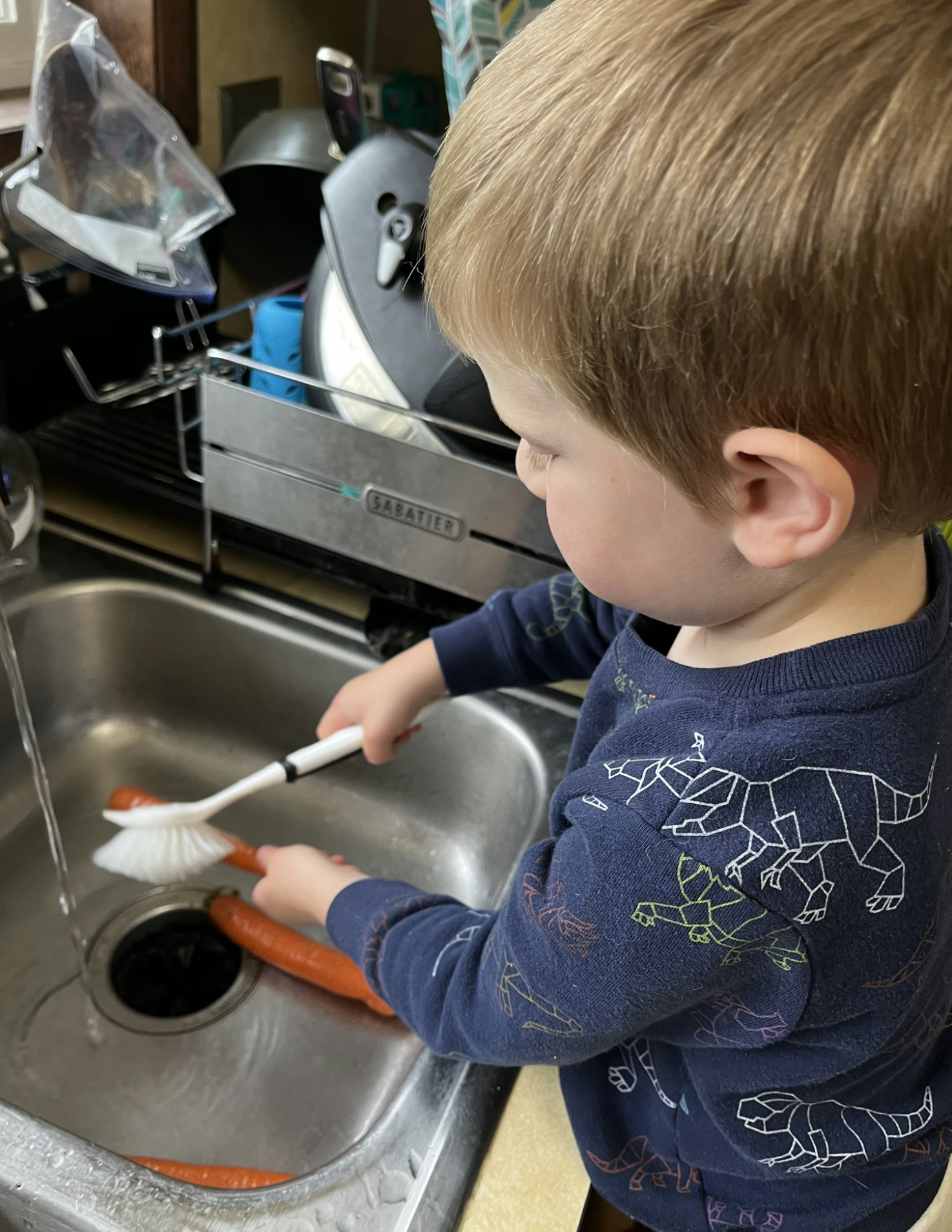
Scrubbing a carrot - photo shared by a Child of the Redwoods family.
Before we jump into curriculum comparisons, I want to say something that I wish more homeschool websites would say.
If you're overwhelmed, it probably isn't because homeschooling is too hard.
It's because you've been asked to make hundreds of decisions before you've even begun.
Every search opens ten more tabs. Every Facebook recommendation leads to another list of "must have" resources. Every curriculum promises to be the one that finally makes everything click. After a while, it's easy to wonder if you're missing something everyone else seems to know.
I've seen this with so many families over the years.
Parents don't usually come to Montessori homeschooling because they want to become curriculum experts. They come because they want a calmer, more meaningful way to learn with their children. But somewhere along the way, they end up feeling buried under choices instead.
The good news is that you don't need to become an expert before you begin. The best homeschool curriculum for overwhelmed parents doesn't ask you to piece together dozens of resources or constantly wonder what comes next. It gives you a clear path so you can spend less time planning and more time enjoying learning with your child.
If you're just beginning and wondering how a complete curriculum fits into the bigger picture of homeschooling, our guide to Montessori Homeschooling for Beginners: Your First Steps with Confidence will walk you through the very first steps and help you see how everything works together.
The Hardest Part Isn't Teaching. It's Deciding What Comes Next.
One of the biggest surprises for new homeschool parents is that teaching often isn't the stressful part: it’s the decision-making!
What should your child learn first?
Should you focus on reading before math?
How much should you cover each day?
Do you need science every week?
What if another family is using something completely different?
Those questions pile up quickly. Even parents who are excited to homeschool can start feeling stuck because every little decision seems so important and dependent upon the other.
Decision fatigue called your name you before you even got started teaching your child, and it is derailing when it happens.
When every lesson, activity, and subject depends on another choice you have to make, your mental energy disappears, and so does your inspiration.
Instead of feeling excited, you feel like you're constantly trying to solve a puzzle with missing pieces.
A thoughtful curriculum removes much of that burden.
Instead of waking up wondering what to teach, you already know where you're headed. Instead of questioning every choice, you can trust the progression that's already been carefully planned.
The security in knowing that there’s a support system in place makes homeschooling feel so much more sustainable.
What Actually Makes a Homeschool Curriculum Helpful?
Here’s where homeschool curriculum shopping gets a little confusing.
A large collection of lessons, printables, book lists, and activities can look incredibly complete. But having more things to choose from doesn’t necessarily solve the problem that made you overwhelmed in the first place.
Because you still have to decide what to do with all of it.
A helpful curriculum has already done some of that thinking for you.
It gives you a course of study. It helps you understand what your child is learning, how one concept builds on another, and what can come next. You shouldn’t have to spend Sunday night piecing together reading from one source, math from another, science activities from Pinterest, and a geography unit you found three months ago and vaguely remember saving somewhere.
That’s not a curriculum. That’s a second job.
If you’re already overwhelmed, look for a homeschool curriculum that gives you:
A clear progression. You can see where your child is now and what they may be ready to learn next.
A comprehensive course of study. You aren’t constantly wondering whether you’ve forgotten an entire subject or missed something important.
Actual teaching guidance. Knowing what to teach is only half the problem. You also need to know how to present it to your child.
Connections between subjects. Learning feels more coherent when reading, mathematics, science, history, geography, and the arts belong to a larger educational plan rather than competing for space on your calendar.
Room to respond to your child. A clear sequence should guide you without requiring your child to move through every subject at exactly the same pace.
That last one matters.
Sometimes parents think they have to choose between a curriculum that tells them exactly what to do and a child led approach where they figure everything out themselves.
You don’t.
You need enough structure to know where you’re going and enough flexibility to respond to the child standing in front of you.
Those two things can absolutely coexist.
Structure and Flexibility Are Not Opposites
This is where Montessori offers overwhelmed homeschool parents something especially useful.
You do not have to choose between having a plan and following your child.
Sometimes “flexible homeschooling” gets interpreted as waking up each morning and figuring out what your child wants to learn. And sometimes “structured curriculum” means everyone moves through the same material on the same schedule.
Montessori asks us to think differently about both.
There is a sequence to Montessori education. Lessons build upon one another. Skills develop over time. Your child isn't simply choosing from an endless assortment of interesting activities.
But that progression follows readiness, not an arbitrary calendar.
Your child might be ready for increasingly complex mathematics while needing more time with reading. Another child might devour books while happily repeating hands on math work that is still helping a concept click into place.
You don't need to push either child forward just because a curriculum says it's Week 17!
And you don't need to invent their education from scratch, either. Neither of these is the Montessori appraoch.
What we’re looking for is balance: a curriculum that can show you the path without demanding that your child march down it at a predetermined speed.
For an overwhelmed parent, this is a breath of fresh air. You can know what comes next without having to scramble. There’s space to move around within.
What This Looks Like in the Child of the Redwoods Curriculum
This balance between structure and flexibility is something we thought about very carefully when creating the Child of the Redwoods Curriculum and that we take very seriously as Montessori guides.
The curriculum gives you a clear educational path without assuming that every child of the same age should be in exactly the same place.
Our foundational lessons are organized into six progressive, spiraling levels. Instead of assigning those levels to specific ages or grades, you use observation and readiness to understand where your child is working.
And that can be different in different subjects.
Your child might be working at one level in mathematics and another in reading and writing. This is normal. It's useful information about the child you're teaching, not a problem you need to fix. Your child isn’t “behind” in one subject. They’re working at their own pace in the level that is correct for them.
At the same time, you aren't left wondering what to teach.
The curriculum provides a comprehensive course of Montessori study across subjects, with fully scripted lessons that help you actually present the material. Concepts build over time, and learning is intentionally connected across subject areas.
So instead of assembling your homeschool one activity at a time, you have a larger educational framework around you.
You can see what lessons your child has been given.
You can understand what they're working on mastering right now.
And you can see what your child might be ready for soon.
That doesn't mean you have to teach everything simply because it's available. Your job is still to observe your child, notice readiness, slow down when more time is needed, and move forward when the moment is right.
The curriculum provides the path.
You remain the guide.
A Good Curriculum Helps You Become a Better Guide
There’s another reason I think good curriculum matters, especially when you’re new to homeschooling.
You’re learning, too!
Most parents don’t begin homeschooling already knowing how to teach reading, introduce the decimal system, recognize readiness, or decide whether a lesson should be repeated tomorrow or put away for a few weeks.
Why would you?
These are things Montessori trained teachers learn. But they aren’t skills most parents come to the table with. And honestly, that is more than okay.
A supportive curriculum shouldn’t assume you already know those things. It should help you gain that knowledge as you teach.
This is especially important in Montessori because your job isn’t simply to deliver lessons in the correct order. You’re learning to observe your child, recognize readiness, understand what you’re seeing, and intuitively make intentional decisions about what to offer next.
That kind of confidence takes time to acquire.
But there’s a big difference between learning as you go with a clear curriculum beside you and trying to teach yourself Montessori while simultaneously planning your child’s entire education.
There’s time to ask questions and mull over the answers before giving a new technique a try.
Eventually, sometime over that first year you do Montessori, the questions that once sent you searching through twelve browser tabs become questions you know how to think through yourself.
That is the kind of confidence a curriculum should help you build.
You Don't Have to Figure Everything Out Alone
If you started searching for the best homeschool curriculum because you feel overwhelmed, you may have assumed you needed to find the perfect program.
I think you need something a little different.
You need a curriculum that takes some of the decisions off your plate without taking away your ability to make thoughtful decisions about your child.
A curriculum can tell you what has been thoughtfully included, how learning progresses, how to present a lesson, and what might come next. It can give you structure when you're unsure and something reliable to return to when homeschool life gets messy. And believe me — it will!
Then, you get to do the part no curriculum can do for you: observe your darling, gorgeous child working hard to learn about their world.
You notice what catches their interest, what needs more time, what they're ready to explore, and when the plan needs to change. They’ll tell you in so many wonderful ways: with their focus, attention, and that twinkling, joyful spirit just eeking out of their wiggly little self as they work.
That's the partnership I want parents to experience with curriculum. You shouldn't have to invent your child's education from scratch, and you shouldn't have to surrender your judgment to someone else's schedule.
You can have a path and still follow your child.
If you’re ready to take the next step, read Montessori Homeschooling for Beginners: Your First Steps with Confidence. It will help you step back from all the curriculum choices and see the bigger picture of how to begin Montessori homeschooling with clarity and confidence.