Montessori Scope and Sequence for Homeschool Parents
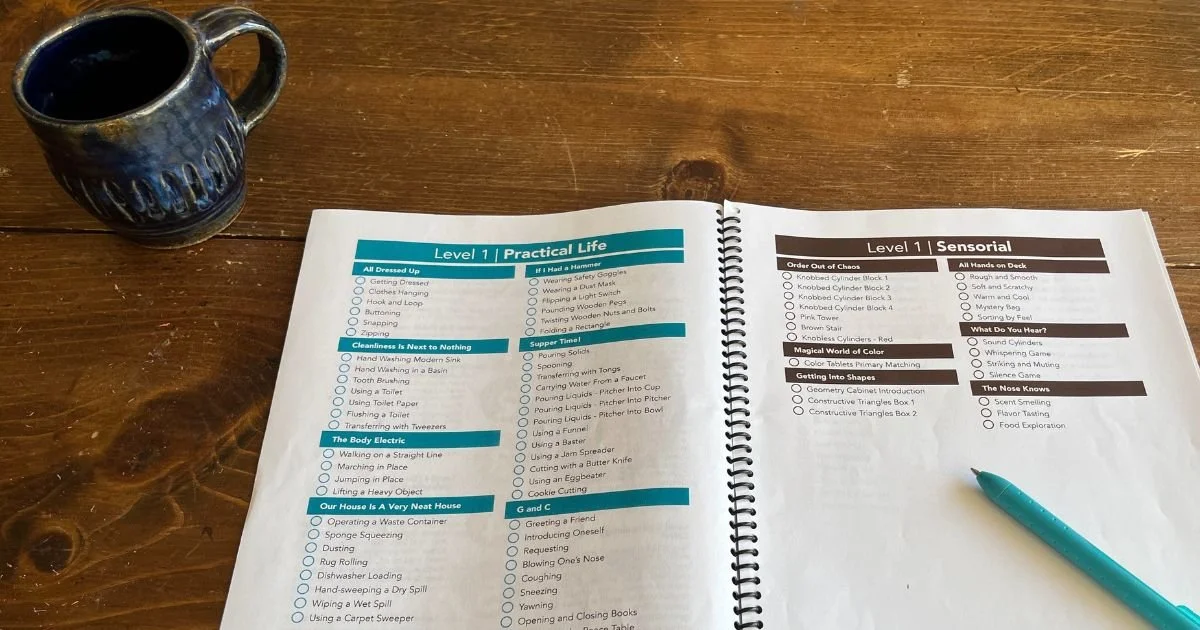
Choosing to homeschool your child with Montessori is making the decision to go on an amazing adventure. It can also be a little scary without the right tools.
Imagine that you’re taking a big road trip across multiple states. You have a destination in mind, and it involves a lush, green paradise and a soft bed full of fluffy pillows. But before you can get to relaxing by the pool, you have to know how to get there.
Would you depart without a map? Just hop in your car and wind your way from one road to another? Well, unless your sense of direction is one in a million, of course you wouldn’t dream of it!
Many Montessori homeschooling parents feel this same tension when planning their days. They can imagine the end result (a confident, well-educated child!) but they worry about getting lost along the way. What should I teach next? Am I missing something important? Is my child falling behind?
This is the very problem a scope and sequence is designed to solve. If you know what’s coming up and what lessons to give in the here and now, you effectively reduce your mental load. No more worrying.
In this article, we’ll take a look at why having a scope and sequence and knowing how to use it matters in a Montessori homeschool and how it enhances your teaching skills over time. (For the full picture of how this fits into a complete Montessori curriculum, you can explore Montessori Homeschool Curriculum for Ages 2-9.)
Why a Montessori Scope and Sequence Matters
A scope and sequence is an invaluable part of any high quality educational curriculum.
Scope is the “big picture” of your entire plan for teaching your child at home.
What exactly will you cover? You’ll want to teach reading, writing, and arithmetic (the three R’s) for sure, but is that all? Not hardly. A quality education, whether at school or home, should cover the arts, sciences, and cultural subjects as well.
When we say scope, we are answering the question about what you will teach your child. For example, if you want your child to become a confident reader, you’ll want to make sure they are exposed to a wide variety of literature, that they are taught the relationship between sounds and letters so they can begin to decode, and you’ll also want them to know how to fluently read a lot of non-phonetic words as well.
These are all lessons you’ll be teaching your child in this wide scope of the Montessori curriculum so that your child is proficient at reading.
The scope of a curriculum ensures that you are providing a robust education across all subject areas.
Sequence is the order you will teach the lessons within every subject area.
It’s great to have a goal of teaching your child to read, but the how is a lot more nuanced. With a solid sequence at your fingertips, you don't need to worry about missing anything important. In the Child of the Redwoods Teaching Guides, every lesson is already organized into six developmental levels, so the next steps are always waiting for you when your child is ready.
This helps you stay aligned with your goals so you can focus on what you need to teach right now. Level 1 provides the easiest Montessori lessons, and you’ll start your child there before progressing to Level 2, and so on.
It’s great to understand the big picture, but the sequence takes you through the Montessori lessons as one concept builds on another. Without it, parents often feel overwhelmed. With a very clear sequence, this anxiety fades away and is replaced by the knowledge that you are taking your child on an educational journey that just makes sense for their developmental abilities and interests.
Over time, the sequence helps you track progression of skills. Whether you prefer checking off Montessori Planning Cards on your kitchen table or using the Child of the Redwoods app to record observations and completed lessons, you'll always be able to see how your child is growing.

How a Montessori Scope and Sequence Works at Home
You may already be aware of the beautiful Montessori phrase, “follow the child”. A scope and sequence is a brilliant tool that helps you do exactly this! As you prepare your environment and begin to teach, you’ll also be observing your child’s current skills.
If the lesson seems frustrating, you can easily shift back to reteach the previous concept. And if it’s so easy that your child sails right through with a depth of understanding and mastery, then you know exactly where to take them next.
A quality scope and sequence guides you from the big picture all the way down to this week's lessons. I like seeing the whole journey inside our Teaching Guides, then pulling out just a few Montessori Planning Cards for the week so I'm only thinking about what my child needs right now.
Your child may move more quickly in some subjects than others, and you can follow their skill and lead them to the next step while moving more slowly in subjects where your child needs more help or a longer time to practice.
For example, when teaching reading, you may stay on the same few lessons for weeks as your child gets more familiar with letter recognition before they’re ready to move on to blending. In math, perhaps your child is just whizzing ahead with all the addition facts; go ahead and introduce multiplication! No need to wait.
The order you give the lessons in is essential for your child’s confidence-building. They move along at their own pace, but you guide the pathway forward through the leveled lessons.
Many homeschooling families, like ours, enjoy a relaxed, joyful life with their children at home! They choose Montessori becuase it offers flexibility and more opportunities for slow living while children develop independence. By choosing Montessori, you’re saying “no thank you” to rigid structure and boring worksheets. Yay for you choosing a different way…a better way!
A scope and sequence allows you to rest easy and enjoy the unpredictable nature of life with small children as you give fun lessons in your home. They grow and change so quickly!
One of your favorite parts will be that you’ll never have to wonder where a lesson lives. If you want to revisit a math activity or find a language lesson connected to something your child is suddenly interested in, you can simply open the Lesson Explorer and search by topic, skill, or Montessori material.
Choosing the Next Lesson with Confidence
Sit down with me a minute because I know where this energy is going. Once you start teaching Montessori lessons, you’re going to be very excited! You’ll see the benefits right away. But after your child learns to sort and classify their first set of printable cards, you’re going to have a big question for me.
“How do I know the right lesson to teach my child next?”
And this is me, reaching gently across the table, pouring a little more hot tea in your cup to warm your hands, and saying this out loud. You already have the most important tool that will answer this question for you: observation.
Choosing the next lesson for your child starts with you and only you. Notice how your child lights up with certain lessons. Take note of your child’s minor frustrations. See what they repeat over and over. What feels hard? What feels joyful? What are they lingering over or continually reaching for?
This is extremely valuable information. And when you have a few solid ideas of the above, your Montessori scope and sequence gives these observations a place to land.
When you notice readiness or interest, you simply open your Teaching Guide and locate the next lesson in the sequence. If you want the complete lesson presentation, you can jump straight to it through Lesson Explorer without digging through binders or trying to remember where you saw it last.
That’s it.
Most parents I work with do it just like this. They glance at where their child is working now within their Level in a subject area, and then they look one step ahead.
You don’t need to plan the whole year. In fact, planning too far in advance does not give you any advantage. You already have the scope (the big picture) of where you are headed. So you just need to get clear on what to show your child this week.
After a lesson is presented, the practice unfolds naturally. Your child returns to the work again and again, deepening their understanding over time. Some materials may stay on the shelf for weeks or months. Others are mastered quickly and discarded in lieu of more interesting tasks. Both are exactly right and will happen spontaneously as your child grows.
And if your child needs to slow down or revisit something you already presented, that is not a failure. That is Montessori in real life, working just as it’s supposed to. Going back and revisiting concepts is part of learning. Repetition builds confidence.
Many parents jot down light notes, put the date beside a lesson, or make a few checkmarks as their child repeats the work. Some families enjoy doing this right on their Montessori Planning Cards, while others prefer recording observations in the Child of the Redwoods app. There isn't a right way. The important thing is making your observations visible so they can guide what comes next.
This is the gift of a clear and simple approach to Montessori. When you know what comes next, today feels calmer and more organized.
Tomorrow suddenly feels easier, too!
A Common Misconception About Using a Scope and Sequence
Let’s talk about what a scope and sequence cannot do for you. It cannot teach your child. It cannot tell you what your child is interested in. It cannot manage your entire schedule, and it cannot follow your child. This is the role of the guide. (That’s you!)
What a scope and sequence does very well is organize the entire curriculum into one clear developmental pathway. That's exactly what our Teaching Guides do. They show the full progression across every subject while still leaving plenty of room for you to follow your child's interests.
I say this all the time to parents in our coaching sessions: you can’t follow a checklist and a child at the same time. We follow the child’s interests and development, and by checking off the lessons in the scope and sequence, we can make the best decisions about how to guide them.
Most of all, in Montessori, we want to avoid rushing our children through a checklist, and sadly, most homeschool curriculums are designed this way, with a traditional approach of having to give prescribed, predetermined lessons that will be mastered on a strict timeline.
A scope and sequence is not a rigid ”to-do list”.
I often talk to parents who have used curriculums like this, and with all the other wonderful things your child is likely doing (going to the park, visiting with friends and family, taking field trips in your community), it’s so easy to fall behind and feel like you will never catch up in time.
It’s natural to feel overwhelmed at the beginning of your Montessori journey, but using a really well-written scope and sequence puts you in the driver seat, not the curriculum. You decide how many lessons to plan for, how often you give them, and whether your child needs a little extra time to practice and process, with zero consequence.
You will never, ever “fall behind” because you are always following your child and guiding them appropriately.
Need more proof? Well, there is a concept we teach in our Montessori courses called “freedom within limits”. The idea is simple. Your child needs both in order to grow and develop into their fullest potential.
Here’s how it works in practice: the scope and sequence provides the limits. We know what we’re going to teach and how we’re going to teach it and in what order.
The freedom lives in how your child responds to the teaching. Your child chooses what they pay closest attention to during a lesson, how long to practice a skill before feeling satisfied with their own progress, and which activities call to them. Just like a nutritious meal you set before them at the table, you choose the content that protects their success.
Some areas of learning truly require order. Reading and mathematics are beautiful examples. One concept builds directly on another, and skipping ahead can create frustration later. Other areas, like cultural studies or the arts, allow for a lot more flexibility and exploration.
Imagine your child choosing between works they are ready for with your careful guidance. Every option supports growth. Every choice they make leads to future success.
Using a Scope and Sequence with Multiple Ages
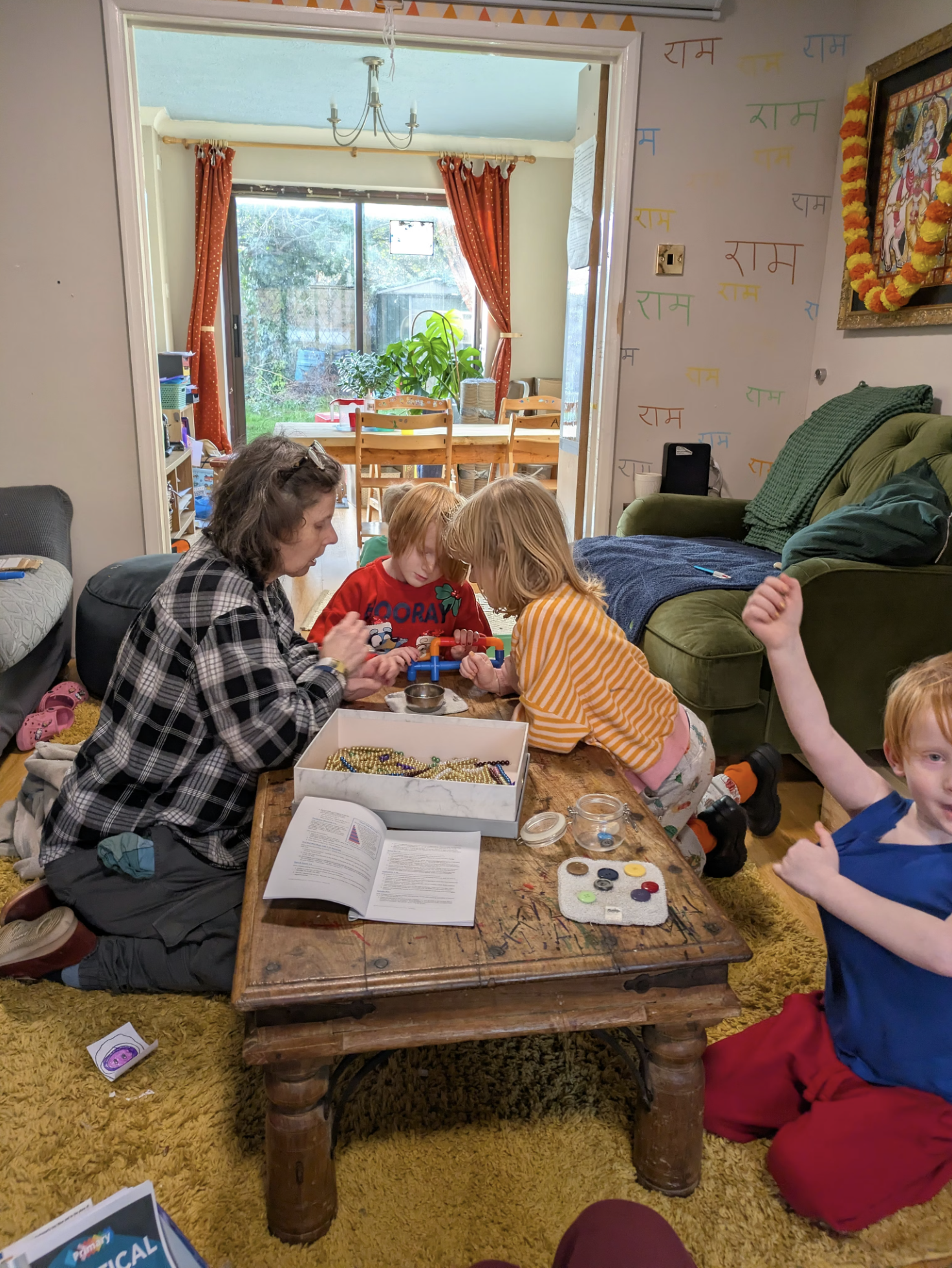
Teaching multiple children using a clear scope and sequence and leveled lessons. Photo shared by a Child of the Redwoods family.
Teaching more than one child at home can feel like juggling plates. One kid working at the counter, another tugging on your jeans, and a baby on your hip! We’ve been there. We think you’re doing awesome just by holding it all together.
A Montessori homeschool scope and sequence is one of the kindest tools for families teaching multiple ages because it lets each child move forward independently at their own pace.
We often bring everyone together with one monthly Theme Pack while each child continues progressing through their own foundational lessons. The shared theme creates wonderful family conversations, while the Teaching Guides make sure each child keeps moving forward at the right developmental level.
Many of our families offer staggered lessons during a shared work period. You might present a short lesson to one child while another works independently. Or you might teach the same lesson but modify it first for one child to make it easier and then scale it up for your older child so they feel appropriately challenged.
The beauty here is alignment, not synchrony. Your children do not need to be doing the same thing at the same time. You can support each of them where they are.
A scope and sequence reduces the mental load of trying to remember who needs what next. It replaces the overwhelm with composure.
Where a Scope and Sequence Fits In the Montessori Approach
A Montessori homeschool scope and sequence does not stand alone. It works hand in hand with the prepared environment, lesson presentations, and observations. In our curriculum, those pieces come together through the Teaching Guides, Montessori Planning Cards, Lesson Explorer, and monthly Theme Packs, each supporting a different part of your homeschool rhythm without making it feel complicated.The environment offers choices.
The lessons introduce new concepts.
Observation tells you readiness and proficiency.
You follow your child freely at their own pace.
This is a homeschool that feels grounded instead of frantic, centered instead of chaotic.
Over time, your child learns so much more than academics. Independence and self-discipline become ways of life. Your child begins to trust their own abilities because the work they are doing makes sense. Your child trusts your guidance because you are there to help them progress surely, steadily toward stronger skills. Learning unfolds in a logical, respectful way.
If you want to see how a high quality scope and sequence fits across all subjects in a complete Montessori homeschool, I invite you to explore the full framework.
Bringing it All Together
Sweet friend, a Montessori homeschool scope and sequence exists for one reason. To give parents exactly what they ask for: peace of mind.
Knowing what to teach next changes how you teach. You can stop worrying about meeting your child’s needs in the future because you know where you’re headed. You can breathe and meet your child where they are today, right now, in this moment.
Tomorrow's lesson is already waiting for you. We may still not know WFD (What’s For Dinner), but we’ve got the homeschooling covered! Your Teaching Guide shows the long term path. Your Planning Cards help you focus on this week. Lesson Explorer makes every lesson easy to find whenever curiosity strikes.
Together, they give you the confidence to stop wondering what comes next and simply enjoy learning alongside your child.