Teaching Multiple Ages in Your Homeschool with Montessori
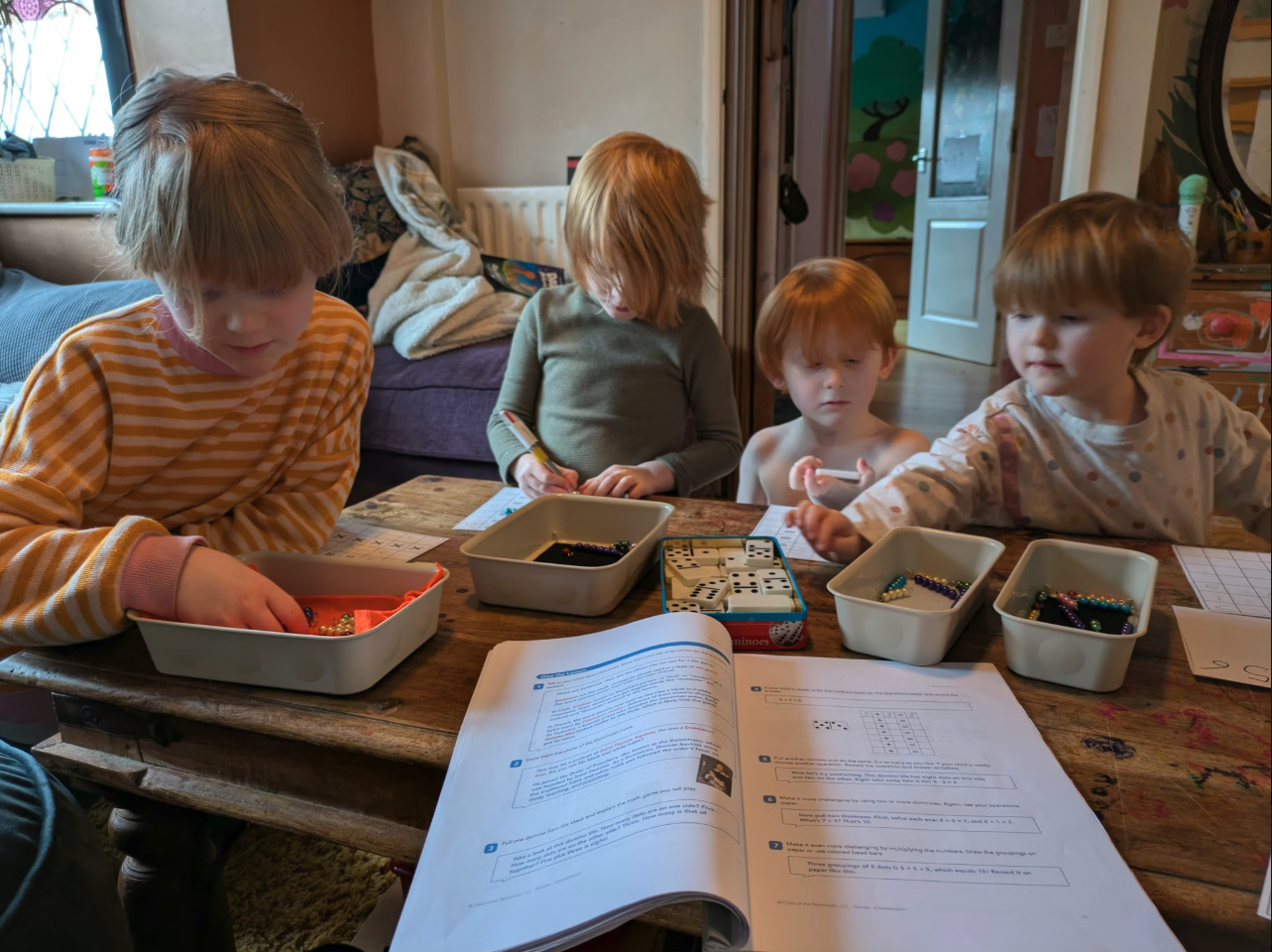
Multi-age math lesson in action. Photo shared by a Child of the Redwoods family.
Homeschooling more than one child? Then, you’ve probably had this thought at least once: How am I supposed to meet everyone’s needs at the same time? Different ages, different abilities, different interests, everyone clamoring for your eyes and hands…it can feel deeply unfair, no matter how hard you try.
Dividing your attention can make you feel like you’re never enough.
You may worry that one child is getting all of the attention while the other is always ignored.
Or you may try to make things “equal” all the time only to realize that your children both think you always play favorites. Is anyone truly getting what they need? The guilt sometimes makes you want to quit and send them to school? We are in the club with you!
Here’s what I want you to remember: with the Montessori approach, we consider it a good thing when children have to compete (just a little bit) for educational resources, like a teacher’s attention or even the materials on the shelf. In fact, mixed-age learning is ideal for fully implementing the method.
This article will walk you through how a Montessori curriculum supports multi-age homeschooling in a realistic and sustainable way, without requiring you to hire a live-in teacher, or clone yourself! Siblings learning to work both alone and together in the same environment is one piece of a larger Montessori framework. If you’d like to see how it all connects across ages and subjects, you can explore the full picture in Montessori Homeschool Curriculum for Ages 2–9 (Comprehensive Guide).
Why Multi-age Learning is Foundational in Montessori
Long ago, Maria Montessori noticed something very interesting about the children in her first classroom, the Casa dei Bambini, or “House of Children”. They varied widely in age from 2 to 6, and yet…they found common ground, teaching each other and supporting one another in their learning, side by side.
The children were not doing the same lessons at the same time, and they definitely didn’t have access to the classroom teacher at all times. In fact, the original Montessori classrooms had quite a high student-teacher ratio! Many Montessori teacher education programs consider a 1:30 or 1:40 ratio for preschool or elementary to be ideal!
In a Montessori environment, children progress based on their readiness for new lessons, not by their birthdays. The younger children observe the older ones working. They carefully watch all of the advanced materials work way ahead of time, getting curious and excited about what they might be ready for themselves. They don’t have to be afraid of new concepts. They see what’s coming up and work to prepare themselves for it!
Older children also benefit greatly from this mixed-age environment. They reinforce their own understanding by modeling these skills to the younger children and explaining their ideas. As the older children take on the role of “teacher”, there is less need for the actual classroom teacher, and so her role is thus transformed to “guide”. The children primarily take the responsibility for teaching each other! Isn’t that amazing? What a beautiful relationship between them!
This same principle translates seamlessly to homeschooling. You don’t need to duplicate materials (or yourself!). Naturally, your children will observe each other and teach one another. Sometimes it may even surprise you that your little one has something important to teach your older. After all, different children have unique gifts, and sometimes skills develop asynchronously.
A perfect balance or equal distribution of your time will sadly never exist. Fortunately, in Montessori, you don’t need it to.
How a Montessori Curriculum Supports All Ages
One of the reasons why Montessori works so well for families with more than one child is because of its emphasis on “following the child”. When every child’s unique developmental needs and skill levels are respected, we can easily cater the lessons to meet them right where they are.
Your children may be willing and excited to learn about the same topics (Lions! Trees! Rocks & Minerals! St. Patrick’s Day!) but the way in which they will engage with these topics will vary greatly. This is to be expected and celebrated in Montessori!
Every monthly Theme Pack in our curriculum includes Everyone Can Play adaptations, making it easy to invite toddlers, preschoolers, and elementary children into the same learning experience while still meeting each child where they are developmentally.
Our monthly Theme Packs make this especially enjoyable because the whole family can explore one topic together while each child participates at their own level. The younger children might sort, match, or explore vocabulary, while older siblings read, write, experiment, or research. Everyone shares the experience without needing separate lesson plans.
Individually, your child will also be able to work at their own pace through the ten core subject areas, such as practical life, sensorial, or life science. It’s math time? Great! Your little one can practice counting objects while your middle child sorts and counts larger numbers of them, and your oldest is playing a subtraction game with them.
The Montessori lessons are designed to build logically over time, allowing each child to move forward independently without restarting the entire curriculum for a sibling. Inside the Child of the Redwoods Teaching Guides, every child follows the same developmental framework, but each one can be working at a different point in the sequence. That means you're managing one curriculum instead of several disconnected ones.
This structure is a big relief for you, dear homeschooler, because you're not juggling three completely different homeschool programs. The Teaching Guides keep each child moving through their own developmental sequence while your shared Theme Packs create family learning experiences everyone can enjoy together.
Shared Rhythms, One Work Period
A question I am often asked in my coaching sessions with parents who are just getting started with Montessori is how to teach two or more lessons at the same time to multiple children in the same home. My answer? It’s impossible! And with Montessori, not even remotely recommended.
You do not need to exhaust yourself trying to teach everyone at once. Montessori lessons need not be lengthy nor every subject covered every single day!
Instead, imagine this: you set up a work period in which your children are encouraged to choose from among the many lessons you’ve given them over the past several months. Ideally, you would have materials that grow with your child and can be used across skill levels, like a set of golden beads.
Many families use the weekly Montessori Planning Cards to choose just a handful of foundational lessons for each child before the week begins. Once those are selected, the rest of the work period unfolds much more naturally because everyone already has meaningful work waiting for them.
While your little one is scrubbing the table like a pro and curiously keeping an eye out for other interesting things happening in the room, your older child is sitting on a rug, working their way through -ot words with the movable alphabet: pot, hot, got, lot. You have on your list to give a new lesson to each child some time during the work period--not all day! And it’s staggered, with short presentations followed by more time for independent practice.
This is Montessori in action. This nice block of time allows your children to engage deeply with their own work while being part of a calm, collective rhythm. When children know what to expect and have meaningful work available, the day flows, one into the next, learning opportunities for everyone and not at all dependent at all on your availability for attention-giving.
Homeschooling Siblings Doesn’t Have to Be Harder

Siblings drawing sunflowers. Photo shared by a Child of the Redwoods family.
Myth: Montessori is harder with more than one child! Reality: Montessori thrives with multi-age learning. Children do not need more time with an adult “teacher”. The time you have to offer them is enough. Your presence and your guidance is enough.
In fact, by reserving some of your time and energy for your own hobbies and household duties, you are sending your children a clear message: you expect them to have their own time to nurture themselves instead of being constantly available for others.
Many parents also fear that their oldest child is being ignored because the baby or toddler demands so much of the caregiving adult. I understand this worry, but the fact is that this is very rarely the case. More likely, your older child has learned how to be comfortable working independently and has entered a new stage of learning and doesn’t need you as much as they used to. This self confidence is a gift, not a deficit. While you’re “busy with the baby”, they are trying out some new skills and learning that in fact, they can be fully competent alone. It’s deeply beneficial!
Equally scary is the worry that your younger child is not getting all the special attention that your older child got at that age. Let me be clear: your children will never have the same experiences in life, and it’s unfair to you to expect yourself to reduplicate them. Instead, try to value each child’s experiences as uniquely wonderful.
It was amazing to have your firstborn all to yourself. They had your undivided attention, and it was a blessing for both of you. And then it was amazing to introduce a younger sibling to them. A future best friend! And now your youngest child has the great benefit of being able to observe and learn from their older sibling. Again, this is an enormous blessing and not to be overlooked. These sibling dynamics will shape them for their entire lives in unique ways that you cannot truly comprehend.
Letting go of these worries and assumptions can dramatically reduce your stress, so please do your children a favor and release them.
Built-In Structure Without Rigidity
Within the Montessori framework is a clear scope and sequence for giving all of the lessons in the whole curriculum. It’s both structured and flexible, and knowing where each applies can help you to feel like homeschooling more than one child is perfectly manageable.
In areas like language and math, the sequence matters a lot! When your child is learning to read, the sandpaper letters must come before the movable alphabet, and both come before your child is truly writing with a pencil. When your child is learning math, knowing how to count is obviously essential before doing operations like addition or multiplication.
Knowing which lessons come in what order is a huge time-saver for you! It helps you to guide your children from one lesson to the next without overthinking the progression.
When you want the bigger developmental picture, you can look at the Teaching Guides. When you’re deciding what to teach this week, you can simply pull out a few Planning Cards for each child. Breaking the curriculum into small pieces makes teaching multiple ages feel surprisingly manageable.
But the curriculum does not enforce rigid rules when it comes to learning. Your children will be learning from one another. This means that your younger child may make a giant leap out of curiosity, and you can embrace it with enthusiasm.
That's one reason I love having the Lesson Explorer available for our members. If one child suddenly becomes fascinated with multiplication because they've been watching an older sibling, it’s easy to quickly pull up the next lesson and decide whether they're truly ready to explore it.
Multi-Age Learning is the Way Montessori was Designed
Siblings learning together is not a special case in Montessori homeschooling. It’s natural and expected, as families come in all sizes. In fact, learning alone is the bigger challenge.
Families with only one child may appreciate their ability to give their child as much undivided attention as they want, but consider this: they must work harder to provide a multi-age environment for their child. This often requires more modeling by the adult and seeking opportunities for shared learning spaces for their children. It is certainly possible, but it does take a deliberate effort.
You, having more than one child in your home already, are providing that multi-age environment with considerably less effort. It’s to be valued, not desparaged.
The extra contagious excitement that arises from your home is an enormous benefit. With thoughtful preparation and high expectations, you can support your children side by side, working on whatever is most interesting to each of them individually.
You’re Right Where You Should Be, At Home With Them
Teaching multiple ages at home is not a deviation from Montessori. It is Montessori.
You don’t need separate plans for each child in your home. You don’t need to split yourself in half to meet their needs. With the Teaching Guides providing each child's developmental pathway, Theme Packs bringing everyone together around shared experiences, and Planning Cards helping you organize the week, homeschooling multiple ages becomes much simpler than most parents expect.
Montessori homeschooling works for real families like yours. Messily sharing snacks at the counter. Awkwardly bumping elbows at the easel. Sweetly reading stories together in your bed. This is the education Dr. Montessori’s dreams were made of!
If you’d like to see how a Montessori curriculum fosters real-life learning across ages in a clear, connected way, your next step is to read Montessori Homeschool Curriculum for Ages 2–9 (Comprehensive Guide) to see the full picture unfold.