Montessori Homeschool for Beginners: Step-by-Step
You’re ready to start Montessori, but you don’t know where to begin? I’ve got you! Starting Montessori homeschooling often feels harder than it needs to be. Not because the ideas are complicated, but because so many parents feel pressure to understand everything before they begin.
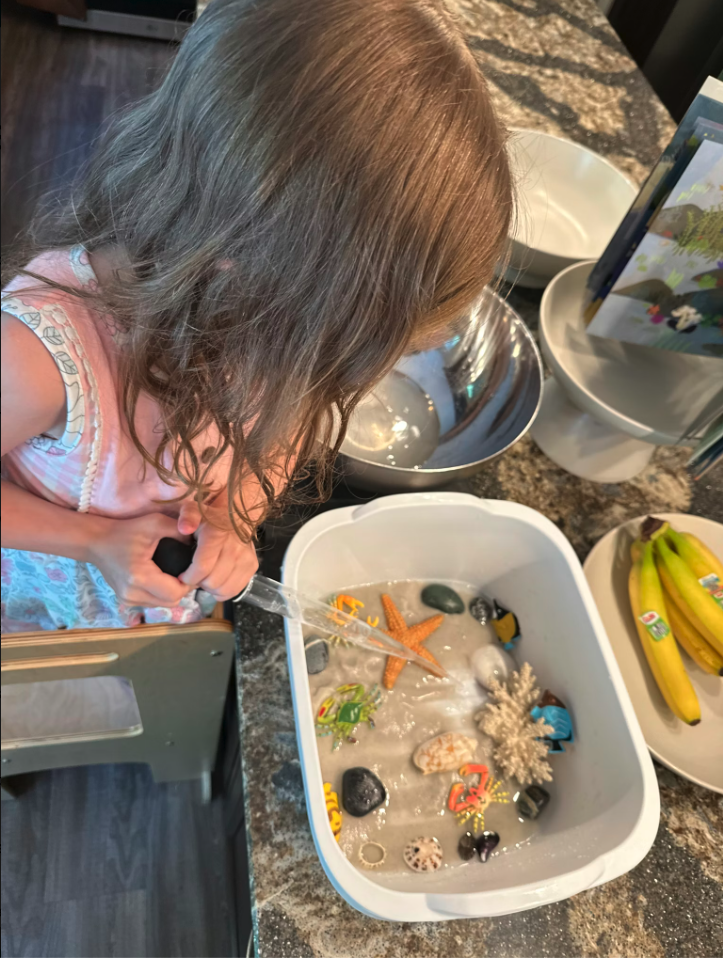
Tidepool exploration as a practical life activity. Photo shared by a member of the Child of the Redwoods family.
You probably have a lot of questions. How to set up? What “counts” as authentic Montessori? How many materials do you need to buy? There’s a lot of uncertainty in starting something new, especially when you aren’t entirely sure whether it will work for you long-term. You don’t want to do it “wrong” on day one, so the worries build up. You wonder if you’re going to mess it up before you even begin!
It’s tempting for parents to let the newness overwhelm them and prevent them from taking the necessary steps to start. You may find yourself in a cycle of reading, researching, and waiting for the “right” information to arrive.
Please, don’t wait, friend. Doing Montessori at home does not require expertise or perfect presentations. You just have to be willing to learn! One step at a time, over time, not all at once. As you practice giving lessons, you will get better. So it’s important not to delay.
Go ahead and take one thoughtful step.
This article offers a step-by-step way of thinking about starting Montessori homeschooling. It’s a gentle framework meant to help you begin your journey. You’ll get familiar with some of the common pitfalls new Montessori homeschoolers experience and how to avoid falling into them.
Confidence is your goal, and that's exactly why we designed the curriculum to help parents learn one lesson at a time instead of expecting them to master Montessori before they begin.
Understand What Montessori Actually Is (and Isn’t)
What is Montessori, exactly? This is hard to define, even for certified Montessori guides. Montessori is a method for teaching children. Dr. Maria Montessori the person was a brilliant scientist and educator. Montessori is a particular kind of school. Montessori parenting is often thought of as a gentle way to help children become independent. It’s all of these things!
Regardless of where we begin in our initial familiarity with Montessori, most people have a certain image in their head of what Montessori “looks like”. You may be picturing in your mind a lovely, calm space for children with shelves and Montessori materials like the pink tower. This is absolutely true, but it’s so much more than this!
When parents say they want to start Montessori homeschooling, they often aren’t sure exactly what this means. Like you, they have heard that there are great benefits. Montessori children are thought of as curious and independent, self-motivated and kind.
At its core, Montessori, whether at home or at school, is an approach to learning that respects how children develop naturally. It emphasizes hands-on learning, careful observation, and thoughtful progressions rather than rushing through content or relying on external rewards.
What Montessori is not is a lifestyle performance like what you may have seen on social media in the past several years. It is not defined by having a perfectly prepared environment, owning every material, or encouraging independence at all costs. It is not a free-for-all where children do whatever they want, nor is it a rigid system that removes adult guidance.
At home, you can “do Montessori” by studying the philosophy, practicing giving your child beautiful, classic lessons, and observing your child’s current skills and needs. You do not need to understand every part of the Montessori method before you begin. As you teach your child and reflect on how your child responds, your knowledge of what to do and how to do it will become solid.
As a new Montessori guide to your own sweet child, you’ll be offering meaningful work, respecting your child’s pace, and allowing the learning to unfold in your child’s own time. That’s a much calmer starting point than most parents expect.
Start With Your Child, Not the Curriculum
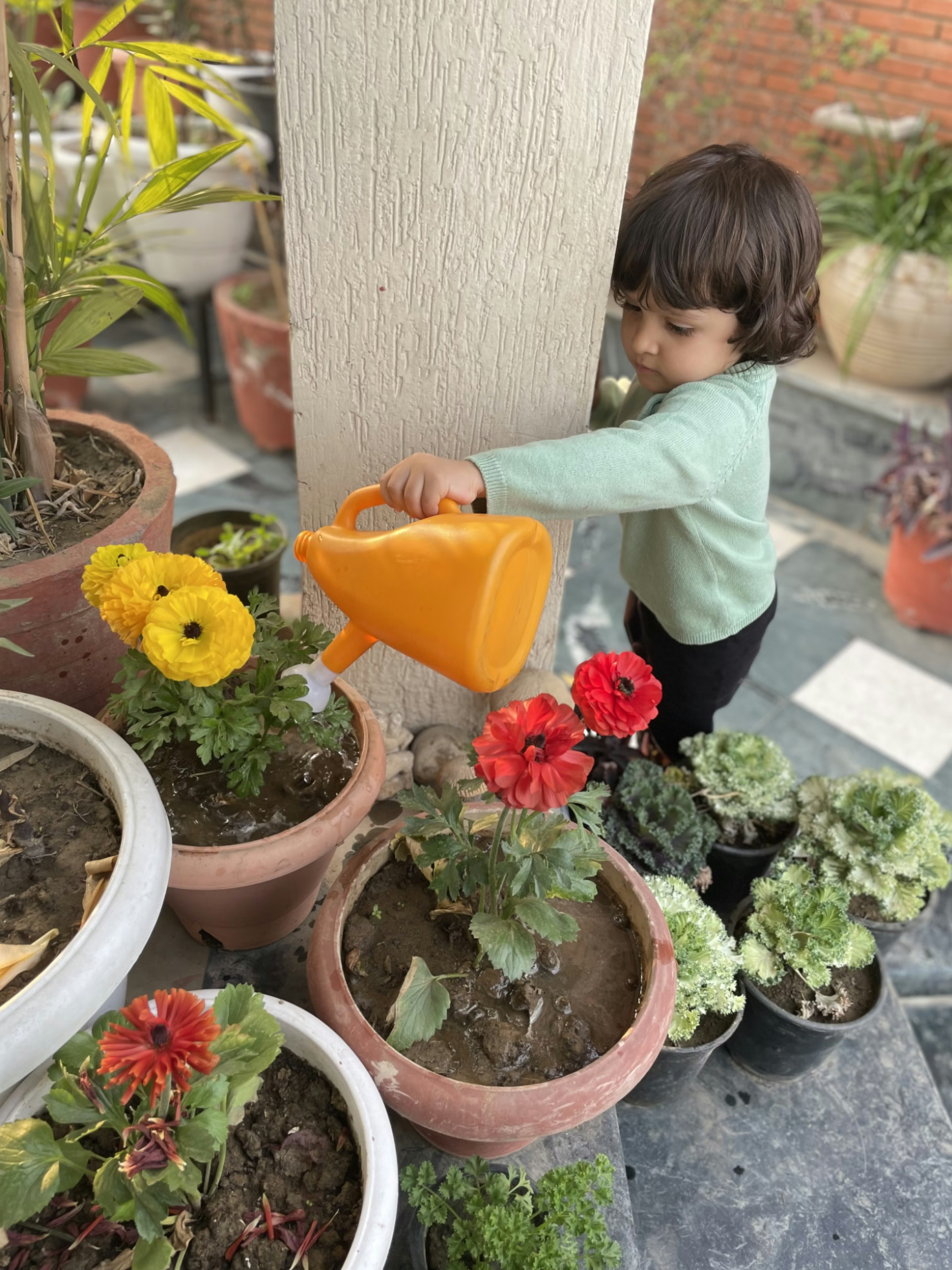
Watering flowers in a home garden, a practical life work. Photo shared by a Child of the Redwoods family.
In the search for the perfect curriculum, many parents assume that they will be opening up a book to the first lesson on page one in August and working their way to the end by May. Montessori doesn’t work like this. Instead, you’ll be starting with your child and following your child.
You only need to observe your own child to know what to teach them. Along with acknowleging your child’s stage of development age-wise, you’ll notice your child’s current interests, their frustrations, and their attention span. You’ll pay attention to what holds your child’s focus, and when they are really excited about learning something new, you’ll especially capitalize on this energy and help them explore it.
The curriculum comes after this initial discovery period (which is part of the method itself!). Once you've spent a little time observing, the Teaching Guides make it easy to match what you're seeing with the next appropriate lesson. Instead of wondering where to begin, you simply meet your child where they are and move forward from there.
This is especially reassuring for beginners, because it means you are not behind if your child hasn’t been exposed to certain skills yet! Starting where your child is builds confidence and prevents unnecessary pressure.
This is a step that many parents are tempted to skip, but now that you know how important it is, that won’t be you! You’ll follow your child, and you’ll never look back!
Choose a Clear Starting Point
Once you begin observing your child, the next challenge is deciding what to teach first.
Many beginners feel tempted to purchase all of the classic materials, set up a bunch of shelves, and then try to teach everything at once—language, math, sensorial, cultural work—in hopes of “doing Montessori correctly.” In reality, this is usually a terrible idea. Talk about setting an impossibly high bar for yourself! Don’t do this. Trust me: you don’t need to buy every classic Montessori material to get started.
Instead, choose one, super clear starting point. Our monthly Theme Packs are designed to gently introduce you to Montessori without overwhelming you. Each one includes fully scripted lessons, printable materials, weekly Planning Cards, and a Welcome Video where I walk you through the month's activities before you begin, so you never feel like you're figuring it out alone.
When you are ready to dip into the foundational lessons, we recommend starting with a single subject area, like practical life. Starting small will build your confidence and your child’s!
Every foundational lesson follows the developmental sequence laid out in the Teaching Guides, so you'll always know what comes next. As your confidence grows, you can easily find those lessons again through Lesson Explorer whenever you want to revisit a concept or follow a new interest.
When you begin with a clear, intentional starting point, you realize how joyful teaching your child at home can be.
Create a Simple, Realistic Rhythm and Routine
You maybe wondering…”What kind of homeschool schedule is best with Montessori?” New homeschoolers often worry about how long it will take to give the lessons, how many activities to do each day, and whether they are doing “enough”.
Eventually the answers to all of these questions will become clear to you, but it will be very unique to your family. Instead of a timed schedule of activities, you’ll be encouraged to think in terms of defining your family’s ideal routine based on your child’s current rhythm.
When you give a few short, focused lessons during your child’s most alert and curious periods of their day, the rest of the day will flow. Children return to work they’ve been shown as often as they choose, deepening their understanding over time. You will spend time every day modeling work as well, so that your child is continually inspired by what they see. And of course there will be lots of time for unstructured playtime, nature walks, playing games, and cooking together.
In the beginning, you will be working hard to find this flow. Inconsistency among your days is normal. Some days will be intuitive and easy; others will feel scattered. This is normal; you’ll be experimenting with what works. But over time, you’ll find your perfect, ideal day.
Many families find it helpful to use the weekly Planning Cards as a gentle guide. Rather than planning an entire semester, they simply choose a few lessons for the week and let the family's natural rhythm shape when those lessons happen.
Giving your child a Montessori education does not require long school days or constant instruction. Homeschooling is not about productivity or maximizing your child’s time learning. We prioritize slow living and giving your child time to think, process whey’re learning, and dream about what they want to learn next! Children are naturally very good at this when allowed to tap into their own inner guides.
As we explore together inside the Foundations of Montessori courses, one of the biggest mindset shifts parents experience is realizing that children need far less direct instruction than most of us were taught to believe.
Let Confidence Grow Over Time
The hardest part of Montessori is developing the patience to let go of what we cannot control. We cannot control our children’s interests in subjects. We can’t control their moods. We can’t control learning outcomes after a lesson. We have to release these in order to truly become Montessori guides for our children.
Doubt and second-guessing are very common for those new to Montessori, especially early on. I promise, you are 100% capable of doing Montessori at home with your own child. You will become more confident with practice and devotion to the method.
Observation of your child will be the feedback you need to know if it’s “working”. Is your child engaged with their world? Joyful in their work? Asking you for guidance when they want to learn to do things for themselves? Repeating work that especially interests them? Then yes, it’s working! This has nothing to do with whether your child ever picks up a classic Montessori material (like the knobbed cylinders) or whether your child chooses anything on the shelf you have lovingly prepared for them.
As you become more confident, you'll notice that planning becomes simpler, too. Your observations naturally guide your next lesson, and the Teaching Guides, Lesson Explorer, and Planning Cards work together so you never have to wonder what comes next.
Doing Montessori right is witnessing your child growing, learning, and being active and present in their world every day. It’s you, giving lessons consistently without overthinking perfection. It’s your family, prioritizing a joyful life, respecting each other’s needs and interests.
The more you trust your child and the method, the more confidence you will have in this absolutely incredible way of life.
Laying a Strong Foundation Will Pay Off
This beautiful Montessori journey is yours to embrace! You don’t have to do everything at once. Taking one step at a time just makes sense when you are learning how to do something new, like Montessori homeschooling.
Based on my work with many thousands of Montessori parents over the last twenty-five years, I can tell you that most of us expect way too much of ourselves. You can definitely do Montessori at home and do it right if you lay a strong foundation.
Taking ourselves out of the learning equation can be problematic. We parents are learners, too! We aren’t all-knowing or perfect people. We’re growing and changing, just like our children are, so why would we treat ourselves any differently?
With a step-by-step approach to learning, we can learn to respect ourselves, trust our intuition, and cultivate a new teacher within us: the Montessori guide.
No Expertise Needed, You’re Ready to Do Montessori!
Are you ready to take that first step? Are you willing? If you are, you’re going to see an amazing transformation over the next few months. Starting step by step is not a compromise. It’s how Montessori was meant to be learned.
You’ll be learning as you teach, alongside your child. It’s not a journey you take alone; it’s a partnership, and you don’t need to know everything first.
Montessori homeschooling does not require expertise. Your perseverance and dedication is plenty and that’s something already within you. So trust the process. Trust that you have the capability to learn a new way of life with your child over time. Observe, adjust, try again, and trust.
You’re so lucky to be a beginner! You get to experience the brilliance of Montessori right from the start. Are you excited yet? I’m so thrilled for you!
If you're ready to take that next gentle step, explore our Montessori Homeschool Curriculum for Ages 2–9. You'll see how the Teaching Guides, monthly Theme Packs, Foundations of Montessori courses, Planning Cards, and Lesson Explorer all work together to help ordinary parents become confident Montessori guides.