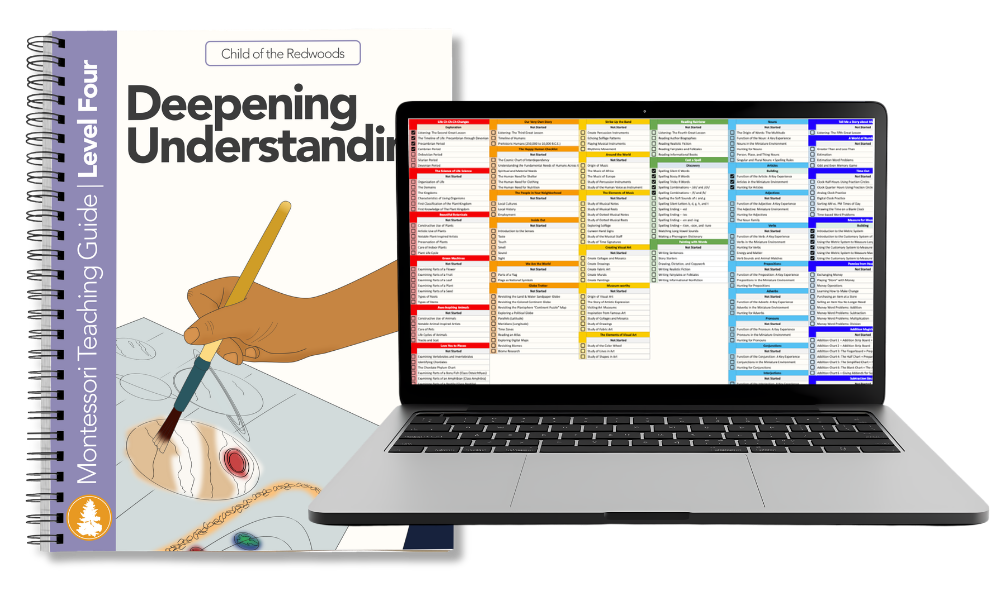
Scope and sequence from Child of the Redwoods
When parents first begin homeschooling, they often imagine there's a secret map that everyone else has somehow been given.
A list.
A timeline.
A chart that says, "Teach this now. Save that until next year."
They're afraid that if they don't find it, they'll accidentally skip something important.
I've heard this worry so many times over the years. In fact, at almost every homeschool park day I've ever been to, there's a new homeschooling parent just waiting for the opportunity to talk to someone who's been doing it for a while.
And they have so many questions!
"What curriculum are you using?"
"How often do you practice math facts?"
"We're just getting started with homeschooling, but I'm not sure we're keeping up with the school system. Is my child behind already? How would I know?"
These questions come from such a loving, thoughtful place.
You want your child to have every opportunity. You want to provide a rich education. Of course you wonder whether you're doing enough! And when you're new to homeschooling, it's easy to assume everyone else has figured out something you haven't.
But here's something I wish more parents understood from the beginning.
Knowing what to teach and knowing when to teach it are actually two different questions.
The first is about understanding how learning progresses. The second is about understanding your child.
And you need both.
In Montessori homeschooling, we use a carefully planned sequence of lessons to understand what skills and concepts build upon one another. Then we observe our children to decide when they're ready for the next step.
You don't need to invent an entire educational plan, and you don't need to follow a rigid schedule that ignores what your child is actually learning.
You need a map, and you need to learn how to read the signs along the way.
If you're just beginning your homeschool journey, our guide to Montessori Homeschooling for Beginners: Your First Steps with Confidence can help you understand how all the pieces fit together.
How Do You Know What to Teach?
Let's start with the map.
In education, we often use the term scope and sequence.
The scope tells us what subjects, skills, and concepts are included in a course of study. The sequence tells us how those concepts build upon one another.
Think about mathematics for a moment.
Before your child can meaningfully understand addition, they need experiences with quantity. They need opportunities to count, compare amounts, and connect numbers with actual objects.
Later, those early experiences become the foundation for more complex mathematical thinking.
The lessons aren't random. There's a relationship between them.
The same is true in reading and writing, science, geography, and the other subjects we teach.
This is one reason Montessori education has such a carefully developed sequence of lessons. Each experience prepares your child for something that comes later.
And that brings us to an important distinction.
You don't have to decide what comes next by looking at what children of a particular age are supposed to be doing.
You can look at what your child has already learned and what naturally builds upon it.
Of course, you need to know what those relationships are in the first place!
That's where a thoughtfully designed curriculum becomes so helpful.
Rather than asking you to research every subject and organize hundreds of lessons yourself, a curriculum with a clear scope and sequence provides that larger educational framework.
It helps answer questions like:
What foundational skills should my child experience before moving into more complex work?
Which lessons build upon something we've already explored?
What subjects should be included in our homeschool education?
What might be a reasonable next step?
But a sequence alone can't tell you exactly when to introduce a lesson.
For that, we have to turn our attention away from the curriculum for a moment.
And look at your child.
How Do You Know When Your Child Is Ready?
This is where Montessori observation comes in.
When I talk about observing your child, I don't mean sitting in a corner with a clipboard, recording every movement like a scientist studying a rare species.
Although I suppose you could. Some days, children are pretty fascinating creatures.
I mean learning to pay attention to what your child is showing you through their everyday work and play.
Let's say your child has been working with counting materials.
At first, they might need your help remembering the number names or keeping track of the objects they're counting.
Over time, you notice that they're becoming more comfortable. They can count a group of objects with increasing accuracy. They begin recognizing quantities without needing as much assistance.
Those observations tell you something.
Your child may be ready for another lesson that builds upon those skills.
Now imagine something different.
Your child has been introduced to a new lesson, but they seem uncertain. They return to earlier materials, repeat familiar activities, or need more time to understand the concept.
That tells you something, too.
Maybe the next step isn't another new lesson.
Maybe it's more practice.
Maybe it's revisiting something familiar.
Maybe your child needs time to explore the concept through their own activity before you introduce anything else.
Readiness isn't simply about whether your child has reached a certain age. It's about what your child is demonstrating through their understanding, interest, and experience.
And here's something important: you won't always know for certain.
Sometimes you'll offer a lesson and discover that your child isn't quite ready.
That's okay.
The lesson itself gives you more information.
You can return to earlier work, offer more opportunities for exploration, or simply wait and try again later.
In Montessori, observation isn't something we do once before teaching. It's an ongoing part of teaching.
We observe, offer a lesson, notice the response, and adjust.
Over time, you become increasingly skilled at recognizing what your child needs.
What If Your Child Is Ready for Different Things in Different Subjects?
Here's where the traditional idea of grade levels can make homeschooling unnecessarily confusing.
We tend to imagine that a child who is six years old should be doing six year old work across the board.
But children don't develop their skills in perfectly synchronized little packages.
Your child might be reading independently while still working with introductory mathematics materials.
Another child might be fascinated by complex mathematical ideas while taking more time to develop reading fluency.
Someone else might spend weeks exploring insects, maps, and the natural world while showing very little enthusiasm for writing.
These differences don't automatically mean something has gone wrong.
They mean your child is an individual.
In Montessori, we don't expect every subject to progress at exactly the same speed.
We look at each area of learning and ask what your child is ready to explore next.
This is one reason the Child of the Redwoods Curriculum uses six progressive, spiraling levels rather than assigning every lesson to a fixed age or grade.
Your child might be working at one level in mathematics and another in reading and writing.
And that's perfectly compatible with the way our curriculum is designed.
Of course, this doesn't mean we ignore subjects that your child finds challenging or simply wait for an interest to appear.
As Montessori guides, we still have a responsibility to offer a broad, thoughtful education.
We prepare the environment, introduce lessons, invite exploration, and pay attention to areas where our children may need additional support.
But we don't have to insist that progress in every subject looks identical.
The sequence gives us direction. Your child's readiness helps determine the pace.
What If You Choose the Wrong Lesson?
I think this is one of the worries hiding underneath the question of what to teach and when.
What if you introduce something too early?
What if you wait too long?
What if you completely misread your child's readiness?
Well, sometimes you will.
I certainly have!
Even experienced Montessori educators occasionally present a lesson and realize that the timing wasn't quite right.
Perhaps your child isn't interested.
Perhaps they need more experience with an earlier concept.
Perhaps the lesson goes beautifully for three minutes, and then your child wanders off to investigate a beetle.
Teaching is full of information like this.
The important thing is what you do with it.
If your child isn't ready, you don't need to push through simply because the lesson was on your plan for Tuesday.
You can pause.
You can revisit earlier work.
You can try a different approach or return to the lesson another day.
And if your child surprises you by understanding something more quickly than you expected, you can respond to that, too.
This is why I don't think of a curriculum as a script for exactly what must happen every day.
Even when the lessons themselves are fully scripted, your decisions about which lessons to offer and when to offer them still matter.
The curriculum helps you prepare and teach.
Your observations help you decide what to do next.
That combination is what makes a Montessori homeschool both structured and responsive.
How a Montessori Curriculum Helps You Make These Decisions
One of my favorite moments during a tour of the Child of the Redwoods Curriculum is when I show parents the full scope and sequence.
You can often hear a big breath of relief.
Suddenly, they can see that there really is a plan.
The subjects are there. The lessons are organized. The progression has been thoughtfully developed.
They don't have to sit down and create an entire course of study from scratch.
That's a tremendous relief, especially when you're just getting started.
Our foundational curriculum is organized into six progressive, spiraling levels across the Montessori subject areas. Lessons build upon earlier experiences, and concepts are revisited and expanded as your child becomes ready for more complex work.
We also provide fully scripted lesson plans so you don't have to figure out how to present every new concept on your own.
And because the curriculum is interdisciplinary, learning in one subject can connect naturally with learning in another.
But I want to emphasize something.
Having a complete curriculum doesn't mean you have to teach every lesson as quickly as possible.
It means you have a thoughtful educational framework to work within.
You can look at the progression to understand what might come next.
You can observe your child to decide whether the time is right.
And you can make adjustments without feeling as though you've somehow ruined the plan.
This is exactly the balance we wanted to create with Child of the Redwoods.
Enough structure that you aren't constantly wondering what to teach.
Enough flexibility that you can respond to the actual child you're teaching.
And enough guidance that you can grow more confident in your own decisions over time.
So What Should You Teach Tomorrow?
Let's bring this back to the question you probably had when you started reading.
How do you know what to teach and when?
You don't need to begin by planning an entire school year.
Start by looking at what your child has already been learning.
What lessons have they been working with? What skills are becoming comfortable? What concepts still need practice?
Then look at the progression in your curriculum.
What lessons build upon the work your child already understands?
Finally, consider what your observations are telling you.
Does your child seem ready for a new challenge? Would more repetition be helpful? Is there a related interest you could respond to?
Sometimes the answer will be a new lesson.
Sometimes it will be another opportunity to practice something familiar.
And sometimes the best decision will be to give your child a little more time.
You don't have to get every decision right the first time.
You do need a way to make thoughtful decisions, notice how they're working, and adjust when necessary.
That's a skill you develop through experience.
And it's one of the most valuable things you can learn as a homeschooling parent.
You Don't Have to Hold the Entire Plan in Your Head
I think one of the biggest misconceptions about homeschooling is that confident parents begin with all the answers.
In my experience, confidence develops as parents gain knowledge and practice making decisions.
You begin to understand how lessons connect.
You notice what readiness looks like for your child.
You learn when to introduce something new and when to give familiar work more time.
And gradually, the questions that once felt enormous become part of the ordinary rhythm of teaching.
You don't need to memorize every milestone or invent your child's education from scratch.
You need a thoughtful educational path, opportunities to observe your child, and the freedom to make informed decisions along the way.
The curriculum helps you understand what comes next.
Your observations help you decide when.
And you become a more confident Montessori guide by learning to use both.
If you're just beginning and would like to understand how this fits into the larger picture, read Montessori Homeschooling for Beginners: Your First Steps with Confidence. It's a helpful place to start building a Montessori homeschool that offers both meaningful structure and room for your child to grow.