Montessori at Home Without Expensive Materials
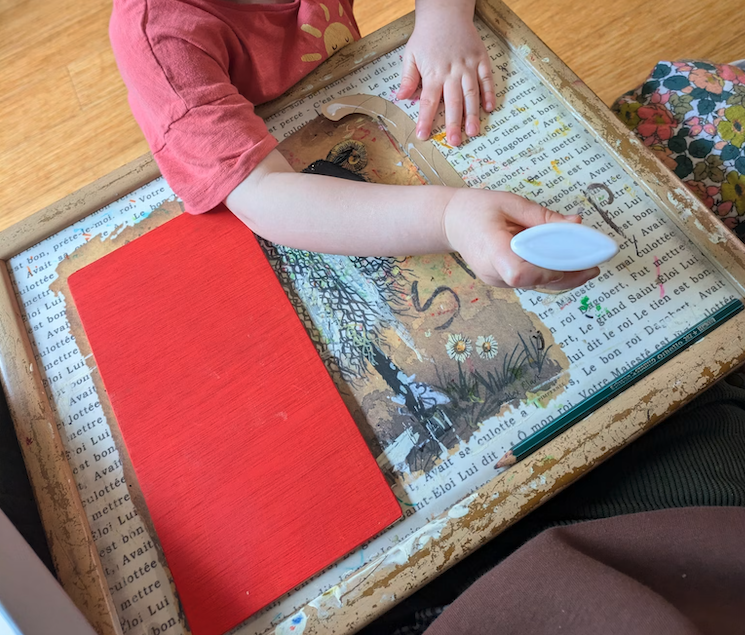
Making homemade sandpaper letters—shared by a Child of the Redwoods member family
Spend a few minutes look up Montessori online and you’ll notice a pattern: beautiful shelves, carefully curated wooden materials, and perfectly prepared spaces that look more like a magazine spread than a real home.
It’s easy to come away with the feeling that Montessori is expensive—and that without the “right” materials, you’re not doing it correctly.
Many parents quietly worry that they’re failing Montessori before they’ve even begun homeschooling. If you don’t own the pink tower, the bead chains, or a full set of wooden trays, are you really offering your child a Montessori education?
Here’s the reassurance you need: Montessori is a method, not a shopping list.
This article will help you understand what Montessori materials are actually meant to do, why home Montessori doesn’t require classroom-scale setups, and what truly matters when teaching your child at home. If you’d like to see how these principles fit into a complete Montessori framework, you can explore Montessori Homeschool Curriculum for Ages 2–9 for the full picture.
The Real Purpose of Montessori Materials
Montessori materials are coveted because they truly do support a hands-on education, which is what all children need in order to grow and develop into their full potential. However, many parents misunderstand their value due to their exclusivity and high cost.
When your child is learning about the objects in their surroundings (e.g., shapes, colors, numbers, words), it is crucial that they first have a concrete, tactile experience with it. Why? Because unlike us adults who live mostly in our heads thinking about what we need to get done tomorrow, children live in the present, the here and now. Their entire knowledge of the world around is tied securely to their senses: what they can see, touch, taste, hear, and smell. They are sensory-seekers.
What they do not experience sensorially, they cannot understand intellectually.
You can see this principle easily in little babies and young toddlers who instinctively reach out to bring objects to their mouth. As a baby feels the textures of objects with their tongues and lips, they are already beginning to categorize the objects in their environment. This one is smooth and cool. This one is soft and neutral. This one is wooly and strange. This one is sweet and warm.
As your child enters a new developmental stage around age 2.5 or 3, their little hands become their primary sensory tools. After all, the human hand contains over 17,000 tactile sensors and free nerve endings! It’s always ready to deliver loads of information to the brain for processing!
Simply by being carefully curated to appeal to and isolate each of your child’s five senses, Montessori materials satiate your child’s desire to learn with their hands. As your child plays, the materials invite them to see patterns, practice skills, and get creative. This is the true purpose.
Many beautiful and thoughtfully designed toys and even regular household objects in your environment can serve this same purpose for your child. They don’t need to be labeled “Montessori” to be beneficial. In fact, this excessive labeling is often a misleading marketing tactic to convince you that you need to buy more stuff.
When parents focus on acquiring materials rather than understanding their purpose, Montessori can start to feel expensive and inaccessible. But when you focus on why a lesson works—what concept it isolates, what skill it builds, what progression it supports—you begin to see many possibilities.
That's one reason our Teaching Guides begin with the lesson itself instead of a shopping list. You'll understand the purpose behind each activity first, then decide whether something you already own, a simple DIY version, or a traditional Montessori material makes the most sense for your family.
Maybe a classic Montessori material is the perfect investment for this particular lesson…or maybe something you already own or something you can easily DIY will do just as well for keeping Montessori affordable for your family.
Why You Don’t Need a Classroom at Home
I want to make this very clear: teaching Montessori in the classroom is not the same as teaching Montessori at home. They are both valid, but they are different learning environments. A guide who is also known as “Mommy” is going to see very different behaviors as a guide who is only interacted with during school hours. One is not better than the other. They are simply different.
In a Montessori classroom, there are ideally many children who are ready for lessons at any given moment and very, very few adults to give them. This is by design. Maria Montessori believed that the children learn best in a classroom from their interactions with multi-age peers and their environment and not so much from the adults “in charge”.
So…it makes sense, but it does require the guide to be able to very quickly and intentionally source the exact lesson from a shelf that one child at any developmental stage might be ready for at that moment.
Every single material in the classroom must always be available for this reason, and that is why an authentic Montessori school has so many materials on so many shelves.
In order for this arrangement to work, the children also must follow certain guidelines; in order to use a material, one must have a lesson with it. In a formal school setting, most children have no issue with a rule like this. It appeals to their sense of order.
In your home, this rule likely makes no sense to your child at all. You are likely just giving lessons to one or a few children at a time, not 20 or 30. You do not need access to every single Montessori material ever created for every subject area. You do not need to restrict your child to play with only the things you have “given them a lesson on”.
It’s your child’s home, not a shared environment with lots of friends and acquaintances, and your child rightfully believes that they should have access to their own toys and learning materials.
At home, you have the advantage of observation. You can notice what your child is drawn to, what they repeat, and what they’re ready for next. You can adapt lessons, simplify setups, and move at a pace that fits your family’s rhythm.
Because you're only planning for your own child instead of an entire classroom, you also don't need every material sitting on a shelf at once. The Teaching Guides help you prepare only what's needed for the next lesson, which keeps both your home and your budget much simpler.
Montessori at home is so much simpler. You don’t need to recreate the classroom.
The Myth of “Doing Montessori Right”
Photos on social media of fully-equipped Montessori homeschool classrooms can be very convincing. They sell you the idea that in order to do Montessori the right way, you must heavily invest financial resources into purchasing the entire set of classic materials in every area.
What many parents do not know is that the typical startup cost for a single Montessori primary classroom at a private school is $20-30K. And that’s just the cost of the materials. Some families may be able and willing to pay this much, but for most, that number alone is a huge turnoff, and honestly, it is not necessary.
The official Montessori materials are not required in order to teach with the Montessori method effectively. They are not required. Nor is a dedicated home “classroom”.
Your home can still be your child’s home.
You can still be Mommy or Daddy or Grandma. Authentic Montessori isn't about collecting every classic material. It's so much more important that you understand the purpose behind each lesson and thoughtfully adapt it for your own child.
As a trained, certified and long-experienced Montessori guide, teaching parents otherwise would not only be perpetuating a myth that thrives among the privileged -- it would be a huge disservice to the legacy of Dr. Montessori herself, who wholly trusted the child.
The Method Matters More Than the Materials
If the materials are fully negotiable as a part of giving your child an authentic Montessori education at home, then your job is to dedicate yourself to this one thing.
The method.
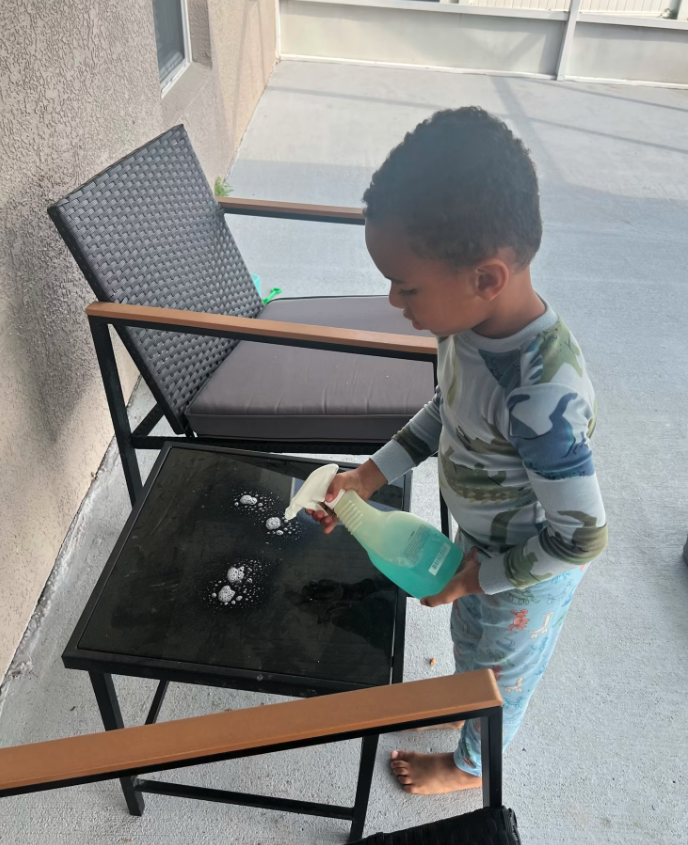
Cleaning patio furniture, a simple but highly effective practical life lesson without expensive materials—shared by a Child of the Redwoods member family
What we now know as “the Montessori method” was not the sole brainchild of Maria Montessori. She learned from others who taught her specific teaching techniques, she tested them with the children she observed, and then the guides she subsequently trained continued to refine these techniques as they taught using the principles she laid for them.
Result: the method worked! It’s brilliant! And now it’s your turn to try them with your own child.
When you truly take the time to learn the Montessori method, you’ll be learning these techniques among others:
How to observe your child and understand their skill level
How to know what to teach your child (follow them!)
How to get your child’s attention and keep them engaged
How to give the three period lesson
How to choose the correct materials to teach a skill
How to simplify a complex idea for your child to understand
How to modify an activity to make it appeal to the senses
How to document your child’s progress
That's exactly what our Foundations of Montessori courses are designed to teach. Instead of asking parents to memorize theory before they begin homeschooling, the courses walk through these ideas in the context of real lessons you'll actually be giving your child.
Consistency with the materials you do use to teach your child with matters a lot more than the variety of materials you use. Why? Many concepts can in fact be taught with the same materials. And some basic materials, like math manipulatives, can be used for years as your child progresses through the curriculum.
Families are often surprised by how many years the same materials remain useful. A single set of math manipulatives or language materials can support dozens of lessons across multiple developmental levels when they're used within a thoughtful lesson sequence instead of as isolated activities.
This is where a clear Montessori scope and sequence becomes invaluable. Inside our Teaching Guides, every lesson builds naturally on the one before it, making it much easier to know whether you're ready for a new material or whether it's time to keep practicing with the one already sitting on your shelf.
Unlimited members also have access to a growing Lesson Materials Library filled with printable cards, maps, labels, timelines, games, and other resources that replace or supplement many traditional Montessori materials. Families simply print what they need as they reach each lesson instead of purchasing everything up front.
Making do is not inauthentic when it comes to Montessori, but relying on the materials to do all of the the heavy lifting will get you very few results. Make it easier on yourself if you can!
Stop Comparing. Start Observing.
Comparing ourselves to others is in our very nature as human beings. It can even have some protective effects. Is your neighbor better prepared for the oncoming storm today? Good reminder! We’d better put our own shutters up so we’re ready, too. Sadly, our tendency to compare ourselves to others more often drains all our joy than is directly helpful.
Social media fuels this in the worst way. When was the last time you saw a post on social media and thought, “She bought that product and it made her life better; I wish I had it, too”?
Be honest…was it the last time you were on social media? Yup. Me, too.
Being online can stoke the most fiery feelings of jealousy. She is better dressed. He gets to go on fancy vacations. They have a full Montessori setup. Their kids go to a beautiful Montessori school. Their kids are using a beautiful material and are deeply concentrating. Cue the jealousy….cue the link click.
Let me tell you something real. Social media is mostly performative. You aren’t supposed to follow your neighbor, friend. You are supposed to follow your child. If the green-eyed monster is eating you, please take a break from the internet. Look at your gorgeous child. Look at your favorite spaces in your home.
You are enough.
Engagement and happiness are far better indicators that learning is happening at home. Your home does not need to look like anyone else’s. Trust what you observe. And after that…well if you want to buy some carefully considered and affordable Montessori materials to own and love, you have my absolute blessing!
In fact, inside the Foundations of Montessori courses, I share exactly which traditional Montessori materials are worth investing in, which ones are easy to make yourself, and which everyday household items work beautifully as substitutes. Parents consistently tell me this saves them hundreds of dollars and a tremendous amount of decision fatigue.
Montessori Was Never Meant to Be Expensive
Giving a child a Montessori education is accessible to everyone, regardless of income or access to specific materials. You can learn the Montessori method and implement it fully without buying a single extra thing. No pricy stuff, elaborate setups, or extensive Amazon wish lists necessary.
Your confidence grows from understanding how your child’s development unfolds, not from owning more possessions.
If you'd like to see how Montessori can stay beautifully simple without sacrificing authenticity, explore our Montessori Homeschool Curriculum for Ages 2–9. The Teaching Guides, Foundations courses, and carefully sequenced lessons help families focus on the method first and the materials second.