1913. The Year Maria Montessori Made a Decision That Still Affects Parents Today
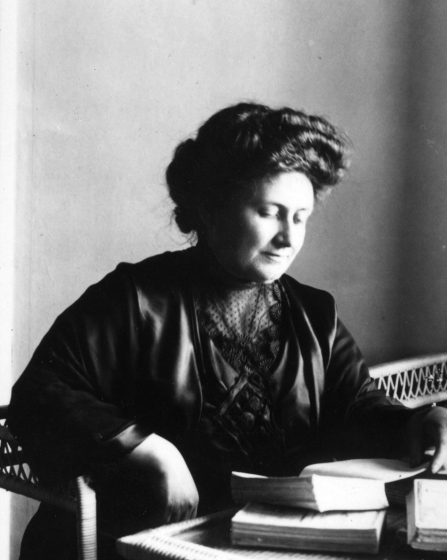
Maria Montessori in 1913, a tumultuous year for her personally.
Spend a few minutes reading about Montessori online, and you might come away with one overwhelming impression.
This is for experts.
You need specialized training. Years of study. A beautifully prepared classroom. Shelves full of expensive materials. Maybe even a certification before you're "qualified" to teach your own child.
I hear this from parents all the time.
"I love Montessori, but I don't think I know enough."
"I wish I had teacher training."
"I'm afraid I'll do it wrong."
Those fears didn't appear out of nowhere. They have a history.
One moment in 1913 helps explain why so many families still believe Montessori belongs only in the hands of experts.
Maria Montessori Was Living Through an Extraordinary Time of Life
When I look at photographs of Maria Montessori from 1913, I see a brilliant scientist and educational pioneer. I also see a woman struggling with midlife.
She had recently lost her mother, Renilde, who died with Maria by her bedside. Friends described her grieving quietly before returning almost immediately to her work. It was an unimaginably difficult season of life.
At the same time, The Montessori Method had captured international attention.
Schools were opening around the world.
Teachers were traveling to Rome from every corner of the globe to learn directly from her.
Imagine carrying the weight of an educational movement that suddenly seemed to be growing faster than anyone could manage!
It's no wonder the expression in those famous photographs feels so serious.
A Personal Reunion
That same year also marked another deeply personal turning point.
Maria's son, Mario, now a teenager, was old enough to publicly recognize her as his mother.
Because he had been born out of wedlock, Maria had made the heartbreaking decision years earlier to have him raised by relatives. Social expectations of the time left women with impossible choices, especially women pursuing professional careers.
Their reunion was emotional and life changing.
History often presents Maria Montessori as calm, composed, and almost larger than life.
But 1913 reminds us that she was navigating grief, family, international attention, and enormous professional pressure all at once.
She was trying to protect something she loved.
Montessori Was Growing Faster Than Anyone Expected
By 1913, Montessori education was spreading rapidly.
Schools were opening in Europe and the United States.
Teachers were giving lectures.
People were adapting Montessori ideas in ways Maria had never considered.
Some of those adaptations were thoughtful, and others misunderstood or oversimplified her work.
If you've ever spent time online reading parenting advice, you've probably experienced something similar!
One person says, "Montessori means wooden toys."
Another says it means never praising your child.
Someone else insists you have to own thousands of dollars worth of materials.
People can get really defensive of their own training and classroom experiences, too — especially if they really, really love Montessori!
When ideas spread quickly, they also become distorted, and Maria saw that happening to her life's work in real time.
The Decision That Changed Everything
In response, Maria announced that teacher training should remain under her direct supervision.
She believed her educational approach was still developing and wanted to ensure it was taught accurately rather than diluted through incomplete or inaccurate training.
Looking back more than a century later, it's easy to understand why she made that decision.
She wasn't trying to make Montessori exclusive. She was trying to preserve its integrity.
Whether history would have unfolded differently had she chosen another path is impossible to know. Many factors shaped the growth and decline of Montessori education in different countries over the following decades.
But one lasting consequence is difficult to ignore: over time, Montessori developed a reputation for being something that belonged primarily to trained professionals.
Do you really need Montessori teacher training to homeschool? Today, most families will say no — and we can help you gain confidence in this.
The Legacy Parents Still Feel Today
More than one hundred years later, I meet parents carrying that same belief.
They assume they need years of training before they can begin! Or they assume Montessori is really best left to “the professionals”.
They worry they'll accidentally "do Montessori wrong."
They hesitate to start because they don't know every lesson or every piece of terminology.
That breaks my heart.
Because while Montessori education is wonderfully deep and worth studying, your child doesn't need you to become Maria Montessori.
Your child needs you.
Your curiosity.
Your love.
Your willingness to keep learning together.
If you're just beginning to explore Montessori at home, you don't have to figure everything out on your own. Read our complete guide to Montessori homeschooling for beginners to see how Montessori can work in a real home, even if you've never taught before.
Montessori Education Doesn’t Need to Intimidate Parents
After years of supporting thousands of homeschooling families, I've learned something important.
Parents aren't looking for permission to do Montessori at home. Typically, before they come visit our website, they’ve already read books or blog posts about Montessori and have chosen this path intentionally.
They need someone to help them understand what comes next in the sequence.
They want reassurance that they're not missing something important.
They want a clear path they can trust.
That's very different from becoming a certified Montessori guide to teach in a classroom.
You don't have to spend years studying educational philosophy before beginning at home with your own child!
What is critical, however, for success is guidance that translates Montessori principles into everyday family life.
That's Why We Created Child of the Redwoods
When we designed the Child of the Redwoods Curriculum, we were absolutely not trying to replace Montessori teacher training.
We were solving a different problem.
Parents would tell us things like:
"I believe in Montessori, but I don't know where to start."
"I've read so many books that I'm more confused than when I began."
"I wish someone would just tell me what to teach next."
So I started teaching Montessori online to parents who wanted to homeschool.
And over the years, with a lot of thought and discussion and vetting of possibilities (often working with other certified Montessori guides who gave feedback and insight), we built a complete Montessori curriculum that gives families exactly that.
Fully scripted lessons! This helps you gain practice giving lessons the Montessori way while offering fun, playful activities to your child.
Interdisciplinary learning! This shows you how children actually learn — not in separate subject areas but by connecting concepts across the curriculum.
Support for multiple ages! Because many families have more than one child at home in completely different stages of development.
A thoughtful scope and sequence that grows with your child! Because to truly understand what Montessori’s about you need to have the big picture, not a micro view of one material at a time.
You don't need to wonder whether you're presenting the right lesson at the right time.
You can spend your energy enjoying the learning instead of trying to recreate a teacher training program in your living room.
Maria Montessori Was Human
One of my favorite things about studying Maria Montessori isn't discovering that she always had the right answer. I mean…of course she made mistakes and made life choices that would be interpreted differently 100 years later!
She was a human being.
She experienced loss, faced criticism, and made difficult decisions with incomplete information, just like the rest of us.
Whether or not you agree with every decision she made, her life's work continues to inspire millions of families around the world.
And perhaps the best way to honor that work isn't by placing it behind another gate.
Perhaps it's by helping more parents discover that Montessori can belong in ordinary homes filled with laundry baskets, snack crumbs, sibling squabbles, and children who are deeply loved.
If you've ever felt like Montessori was only for experts, I hope you'll leave this page believing something different.
You don't need anyone’s permission.
You don't need perfection.
You don't need years of teacher training before you can help your child grow.
You simply need a soft place to begin.
If you're ready for that next step, explore the Child of the Redwoods Curriculum. We've built it to give families the confidence, structure, and support that so many parents are searching for, while staying true to the spirit that made Montessori's work so revolutionary in the first place.